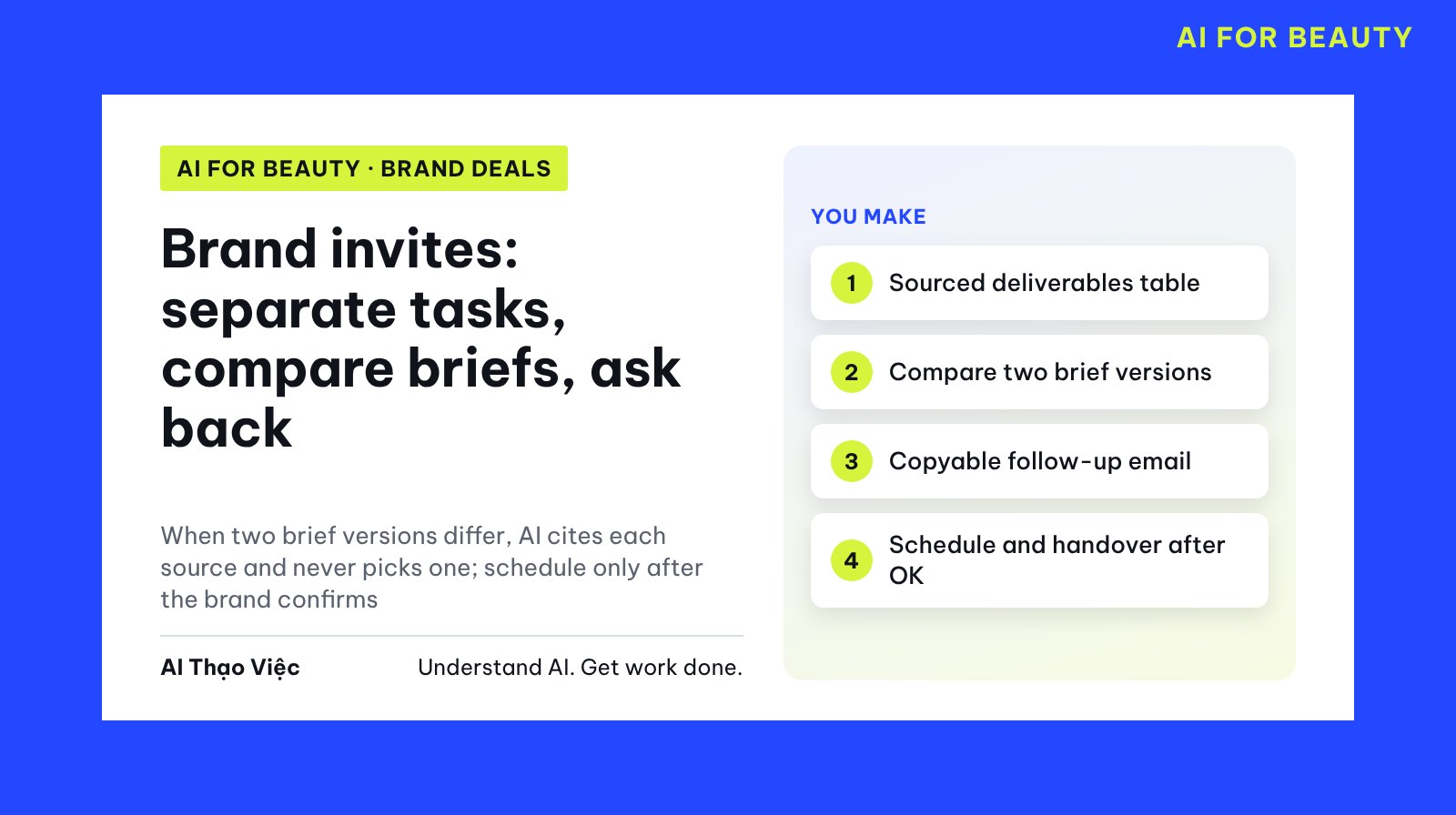
This article helps you handle a collaboration invite from a brand before you say "yes": use AI to quote each request exactly, separate what is settled from what is unclear, compare it with your schedule and capacity, then draft one follow-up email. The work schedule is planned only after the brand confirms. This is a method for reading and asking, not a way to negotiate fees or a source of contract advice.
A common situation: the brand sends two emails a few days apart, and each says something different. AI tends to take the latest version and treat it as final. Here, AI must point to the source of each version so you can ask.
A few terms used here
- Prompt (the request you type to the AI): the text you paste into ChatGPT, Claude or Gemini.
- Brief (the assignment): the document in which the brand describes what it needs: product, message, quantity, deadlines.
- Deliverable (what you must deliver): the specific thing you hand over, for example "1 TikTok video, 30 to 45 seconds".
- Revision rounds: how many times the brand may give feedback and you edit the draft.
- Exclusivity: a commitment not to work for competing brands for a period of time.
- Ads using creator content: the brand uses your video to run paid ads.
- Call time: the time you must arrive at an event or shoot.
Prepare sources and remove private details
- Copy the email content into plain text. Remove phone numbers, addresses and personal signatures; do not paste real contracts or account numbers. Keep the send date of each email: that is what tells the two versions apart.
- Note your free days for the next 3 weeks and the real hours you need for one video (shooting, editing, exporting).
- Your personal service list: paste the descriptions, keep the prices to yourself.
Step 1. Quote each request word for word, with a source per line
Example: Lan Chi (simulated), a beauty creator and photo model, receives an invite from the fictional cosmetics brand Hoa Mộc.
VERSION 1 · email dated 28 Oct 2026, Mr. Quốc Bảo (Hoa Mộc communications)
Hi Lan Chi, Hoa Mộc invites you to make 2 TikTok videos introducing Hoa Mộc lip balm.
Send drafts before 10 Nov, post on 15 Nov. The brand gives 1 round of feedback.
We invite you to appear at the store opening event on 20 Nov, 2 pm to 5 pm, Ho Chi Minh City.
The brand may reuse the videos. Fee to be discussed later.

VERSION 2 · email dated 30 Oct 2026, Mr. Quốc Bảo
Update: the package includes 3 videos (2 TikTok, 1 Facebook Reels). Product will be sent to you on 5 Nov.
Drafts before 8 Nov, post on 12 Nov. The brand gives 2 rounds of feedback.
The brand will use the videos to run ads for 30 days.
For 3 months you will not work with any other lipstick brand.

LAN CHI'S SCHEDULE AND CAPACITY
Each video needs 3 hours (shooting, editing, exporting).
Available shooting days: 7 Nov (6 hours), 9 Nov (6 hours), 13 Nov (6 hours).
12 Nov: already booked for another job all day. 20 Nov: free in the afternoon.
Personal services: product videos for products I have tried; event appearances.
This data set has deliberate traps: the number of videos, posting date, draft deadline and revision rounds differ between the two versions; version 2 does not mention the event; neither version names the approver or a specific fee.
I am pasting two collaboration emails and my schedule.
Only quote what the emails say. Do not infer, do not fill anything in.

Make a table: Item | Exact wording | Source (Version 1 dated 28 Oct or Version 2 dated 30 Oct).
Items to look for: deliverables, channel, quantity, draft deadline, posting date,
revision rounds, approver, product shipping date, event, video usage rights,
paid ads, exclusivity, fee.
If an email does not mention an item, write "not stated" and say which version.
If an item appears in both versions, split it into two lines.
Step 2. Separate matching, conflicting and not stated
From the extraction table, make a comparison table:
Item | Version 1 (28 Oct) | Version 2 (30 Oct) | Status | Question to settle.
Status may only be: Matching / Conflicting / Stated in one version only / Not stated.
Rules:
- When the two versions differ, do NOT pick either one. Write both, status Conflicting.
- Do not treat the newer version as final, unless the email clearly says "replaces the previous version".
- Fee, video usage rights, paid ads, exclusivity: only record them and ask a question.
Do not comment on whether anything is reasonable, do not suggest prices, do not conclude who has which rights.
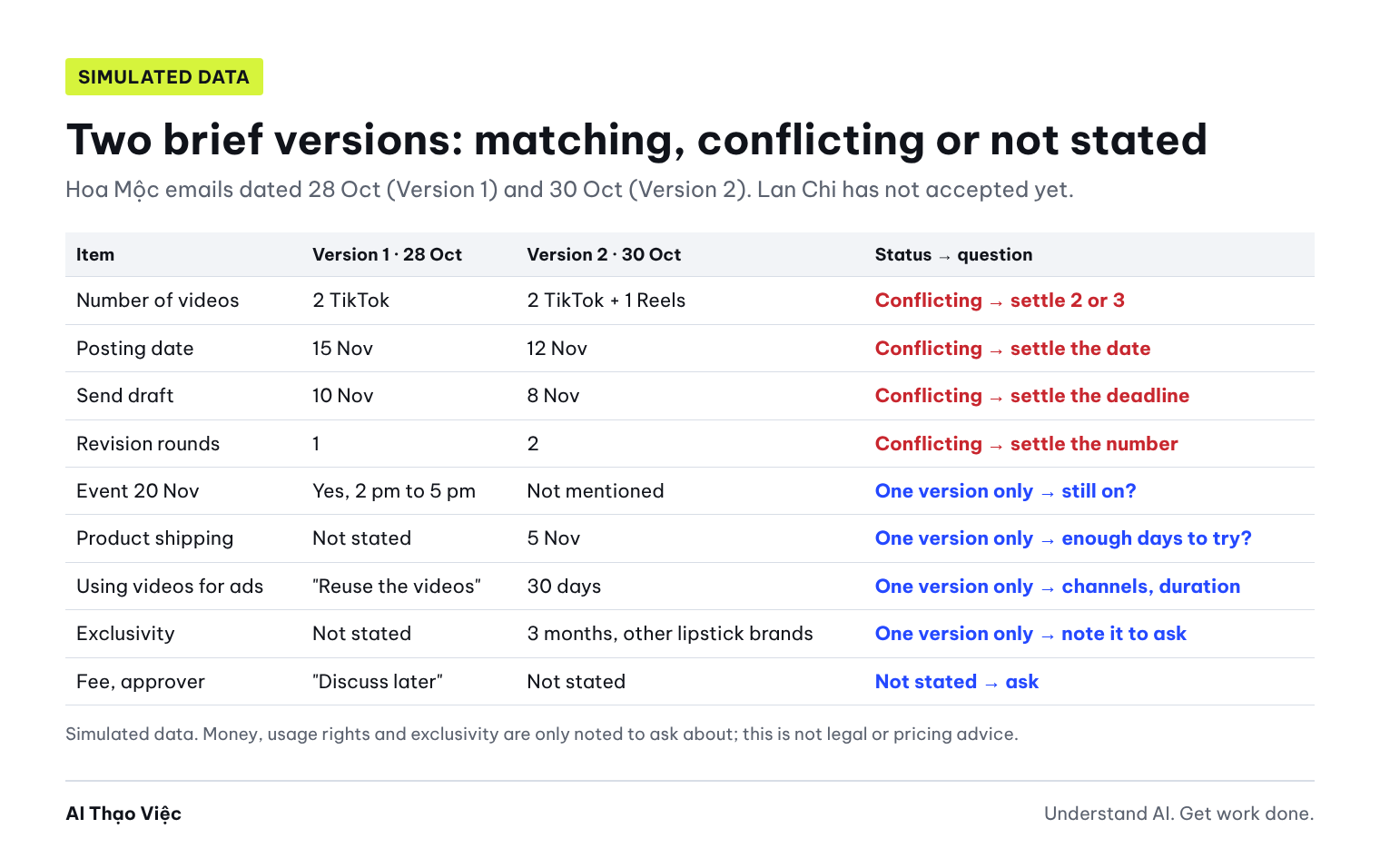
Editorial answer: 4 conflicting items (number of videos, posting date, draft deadline, revision rounds); 4 items stated in one version only (the 20 Nov event in version 1; product shipping date, 30-day ads and 3-month exclusivity in version 2); 2 items not stated in either version (approver, specific fee). On video usage rights, version 1 says "reuse the videos" with no time limit, and version 2 says ads for 30 days: these two sentences do not describe the same thing, so it is still a question.
Step 3. Check against your capacity and schedule
Compare each option in the comparison table with my schedule and capacity.
For each option (per Version 1, per Version 2), write:
- Total hours needed = number of videos x hours per video. Show the calculation.
- Which shooting days can be used before the draft deadline.
- How many days I have the product in hand before the first shooting day.
- Whether it clashes with jobs I have already accepted.
The conclusion may only be: On time / Not on time / Not enough information. Do not choose an option for me.
Editorial answer:
| Option | Hours needed | Shooting days before draft deadline | Issue | Conclusion |
|---|---|---|---|---|
| Version 1: 2 videos, drafts 10 Nov, post 15 Nov | 2 x 3 = 6 hours | 7 Nov or 9 Nov | Version 1 does not state the product shipping date | Not enough information |
| Version 2: 3 videos, drafts 8 Nov, post 12 Nov | 3 x 3 = 9 hours | Only 7 Nov (6 hours) | 3 hours short; product arrives 5 Nov, only 2 days of use before shooting; 12 Nov already booked | Not on time |
Two days of trial use is a point to ask about, not a minor detail. Law No. 75/2025/QH15 amending the Advertising Law (Luật Quảng cáo sửa đổi, in force from 1 Jan 2026), Article 15a, clause 3, point a, says of influencers: if they have not used or do not clearly understand the product, goods or service, they must not introduce it. Whether you fall into this group, and how long counts as "having used" a product, this article does not conclude. This is not legal advice; ask a qualified professional before you sign or post. What you can do right away: only say what you have experienced, and ask to receive the product earlier.
Step 4. Draft a follow-up email
Draft a reply to Mr. Quốc Bảo, polite and short.
Opening: thank him and say I want to settle the details before confirming I accept the job.
Body: number the questions. Each question about a conflicting item must state both versions
and the email dates, for example "the 28 Oct email says..., the 30 Oct email says...".
Add questions for the items not stated: approver, fee, scope and duration of video use,
which products the exclusivity covers, whether the brand needs me to turn on the paid content label and tag the brand's account.
Give one schedule proposal based on my capacity, clearly marked as a proposal.
Do not agree to or refuse anything about money, usage rights or exclusivity.
Do not use the words "definitely" or "commit".
Expected output, Editorial answer (written by the editors, not yet run on a real AI tool):
Subject: Hoa Mộc x Lan Chi: settling details before I confirm

Hi Mr. Quốc Bảo,
Thank you for the invitation. I would like to settle a few points before confirming I accept the job:
1. Number of videos: the 28 Oct email says 2 TikTok videos, the 30 Oct email says 3 videos (2 TikTok, 1 Reels). Which package are we going with?
2. Posting date: the 28 Oct email says 15 Nov, the 30 Oct email says 12 Nov. I already have another booking on 12 Nov.
3. Draft deadline: 10 Nov or 8 Nov? Feedback rounds: 1 or 2?
4. Store opening event on 20 Nov, 2 pm to 5 pm: the 30 Oct email does not mention it. Is the event still on, and what is the call time?
5. Product: I need to try it before shooting so I only talk about what I have experienced. Could you send it earlier than 5 Nov?
6. Who approves the drafts, and how long does each feedback round take?
7. Video usage rights: the 28 Oct email says "reuse the videos", the 30 Oct email says ads for 30 days. Could you send me the channel scope and duration?
8. Which products does the 3-month exclusivity apply to? I need to see it before I reply.
9. Fee and payment terms: could you send them to me in writing?
10. On TikTok, do you want me to turn on commercial content disclosure and tag the Hoa Mộc account?
Schedule proposal (not yet a confirmation): if it is 3 videos, I send drafts on 10 Nov and post from 15 Nov.
I look forward to your reply.
Lan Chi
Step 5. Plan the schedule only after the brand confirms
Suppose that on 1 Nov Mr. Quốc Bảo replies by email: 3 videos (2 TikTok, 1 Reels), product shipped 3 Nov, drafts 10 Nov, 2 feedback rounds, the approver is Mr. Quốc Bảo, replies within 1 day, posting 15 Nov, the 20 Nov event stays as planned, call time 1 pm. Fee, video usage rights and exclusivity "will be sent in the contract".
The brand confirmed by email on 1 Nov (pasted below).
Plan a work schedule: Date | Task | Hours | Who does it | Who approves | Source of confirmation.
Only use information confirmed on 1 Nov. Any item still "will be sent in the contract"
goes into a separate "Not settled" table, not into the schedule as if agreed.
Then make a handover sheet for each video: file name, channel, posting date,
revision rounds used, approver, approval date, whether the commercial content label is on.
Editorial answer (shortened schedule):
| Date | Task | Hours | Approval |
|---|---|---|---|
| 3 Nov to 6 Nov | Receive the product, try it, keep a daily usage diary | 10 to 15 minutes a day (estimate) | Lan Chi |
| 7 Nov | Shoot and edit 2 TikTok videos | 2 x 3 = 6 | Lan Chi |
| 9 Nov | Shoot and edit the Reels video | 3 | Lan Chi |
| 10 Nov | Send 3 drafts | Mr. Quốc Bảo, round 1 feedback before 11 Nov | |
| 13 Nov | Edit round 1, resend; round 2 before 14 Nov | Up to 6 | Mr. Quốc Bảo |
| 14 Nov | Edit per round 2 feedback (Lan Chi must confirm she has the hours) | To be confirmed | Mr. Quốc Bảo |
| 15 Nov | Post; turn on commercial content disclosure, tag the brand account if agreed | Lan Chi | |
| 20 Nov | Store opening event, arrive at 1 pm | 1 pm to 5 pm | Per the event plan |
"Not settled" table: fee, video usage rights, exclusivity. No signature, no shooting.
On platform labels: the TikTok help page says that when a post promotes a brand, product or service, you must turn on the commercial content disclosure setting; choose "Branded content" when promoting a third party and tag the partner, and the post will show a "Paid partnership" label. The page also says the default authorization period for a partner is 60 days: this number differs from the 30 days in the email, one more reason to ask. Law 75/2025/QH15, Article 15a, clause 3, point b, also states that influencers must announce the advertising right before and during it. How this applies to your case: ask a qualified professional.
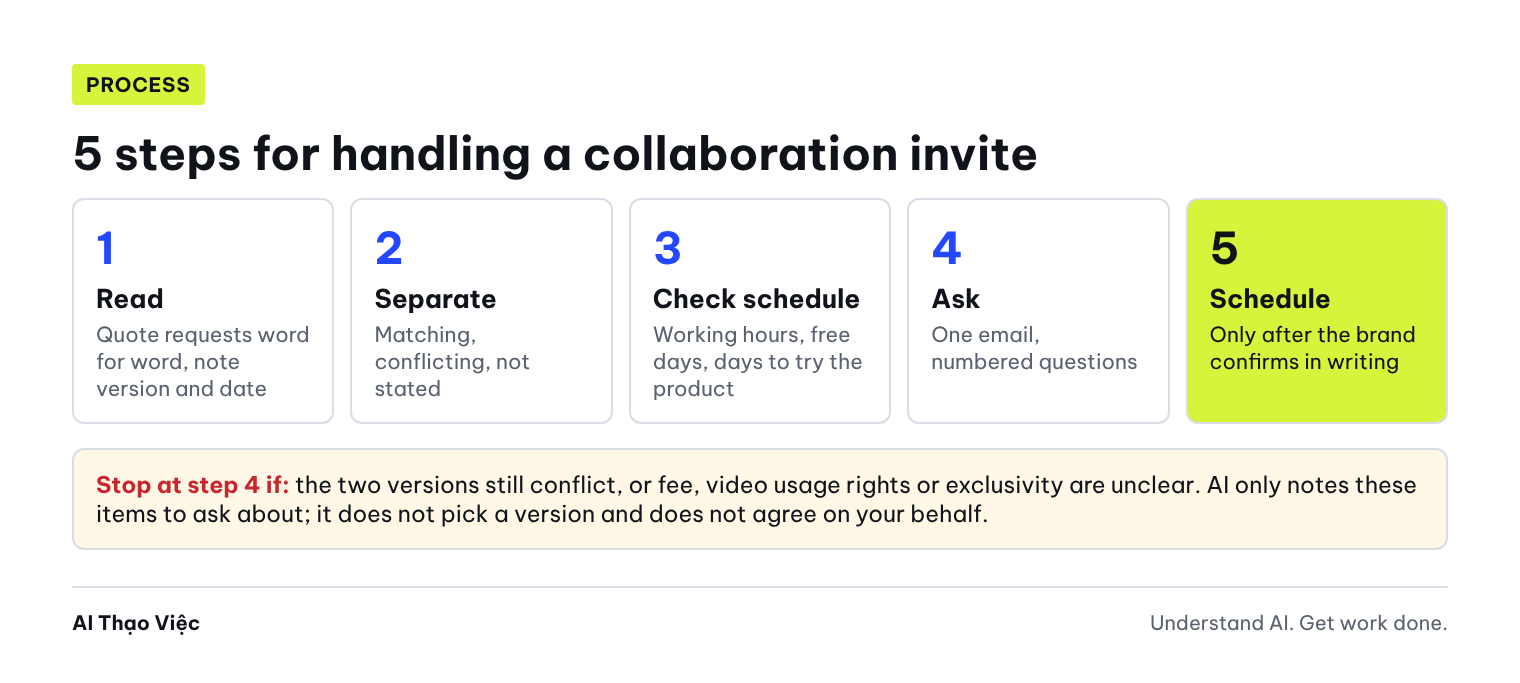
Spot wrong output
- Picks a version on its own: AI writes "Package: 3 videos, post 12 Nov" as if settled, without mentioning that the 28 Oct email said 2 videos, 15 Nov.
- Approves terms on its own: AI writes "3-month exclusivity is common, you can agree" or suggests a fee.
- Schedules too early: AI produces a shooting schedule for 7 Nov right after step 2, when the brand has not replied.
- Forgets capacity: AI says "on time" for version 2, when 9 hours of work only has 6 hours of shooting before the deadline.
How to check: every line has the source "Version 1" or "Version 2"; search for the words "common", "reasonable", "should agree"; redo the hour calculation yourself.
The table you just made breaks the rules. Fix it:
1. For any item where the two versions differ: write both, with the email dates, status Conflicting. Do not pick either one.
2. Delete every comment on whether exclusivity, fee or video usage rights are reasonable or common. Keep only the questions.
3. Delete the work schedule; the brand has not confirmed.
4. Recalculate the hours for each option, showing the calculation.
List the lines you changed before giving the new table.
Use it with your own data
- Gather every email and message for the same invite. Note the send date of each version and sort them by time.
- Remove personal details, account numbers and real contracts before pasting.
- Note the real hours you need for one video and the days already booked for other jobs.
- Run prompts 1, 2 and 3. Check at least quantity, posting date and draft deadline against the original emails yourself.
- Reread the follow-up email before sending; you are the sender.
- Only run prompt 5 once you have written confirmation. Contracts, fees, image usage rights: ask a qualified professional before signing.
A suggestion for workshops or classes: work in pairs, one person plays the creator, the other plays the brand and writes two emails with mismatches. The creator uses prompts 1 to 4 to complete the requirements table and the follow-up email; the brand replies; then swap roles.
Check before you use it
- Every line in the deliverables table shows which email and which date it came from.
- Every place where the two versions differ is marked "Conflicting", not merged into one.
- Items not stated say "not stated", not filled in by AI guesses.
- Total hours for each option recalculated by hand.
- The number of days with the product in hand before shooting has been counted.
- Fee, video usage rights, paid ads and exclusivity appear only as questions.
- The follow-up email does not agree to or refuse anything on your behalf.
- The work schedule exists only after written confirmation, with unsettled items kept separate.
When things go wrong
- The brand replies by phone: send a summary email, "here is what I noted", to get written confirmation.
- There is a third version: add a dated Version 3 column and rerun prompt 2; do not overwrite the old table.
- The brand pushes you to accept now and settle later: say clearly that you need the conflicting items settled first; accepting or not is your decision.
- Not enough days to use the product: ask to move the shooting date or receive the product earlier; do not say what you have not experienced.
- AI still suggests prices: delete that part; pricing is your decision, and you can refer to your own price list as in the article standard price list and request form.
Limits and sources
The characters, brand, emails, schedule and answers were written by Tổ Thạo Việc (the AI Thạo Việc editorial team) using simulated data; the prompts have not been run on a real AI tool and work with text AI assistants such as ChatGPT, Claude and Gemini. This article gives no legal advice, no market pricing advice, and does not conclude who has which rights; ask a qualified professional before signing or publishing. Meta's help pages on branded content tools have not been checked.
- TikTok, How to turn on the Commercial Content Disclosure setting and About the content disclosure setting for creators, read on 31 Oct 2026.
- Luật sửa đổi, bổ sung một số điều của Luật Quảng cáo, No. 75/2025/QH15 (Law amending and supplementing a number of articles of the Advertising Law) (version published on the Hanoi government portal), Article 15a and Article 3, read on 31 Oct 2026.
Read next: Sending products to affiliate creators (in Vietnamese) to see the brief from the shop's side, and Writing work emails (in Vietnamese) to adjust the tone of your follow-up email.