A wrong makeup quote is usually not wrong on the main price but on the extras: is 18 km charged as 18 or 8 km, does four people include the bride, what happens to the deposit if the client cancels. Clients remember exactly what you messaged. If your price notes can still be read two ways, AI will also pick one reading, and it may not be the one you want.
This is article 1 in a two-part series for freelance makeup artists. This article builds the standard price list and the request form; article 2 uses them to write a quote for a specific request. How to write a general follow-up email after a call is covered in the article on follow-up emails that make no promises of their own (in Vietnamese); this article goes into the extras specific to the trade: early starts, travel, assistants, groups.
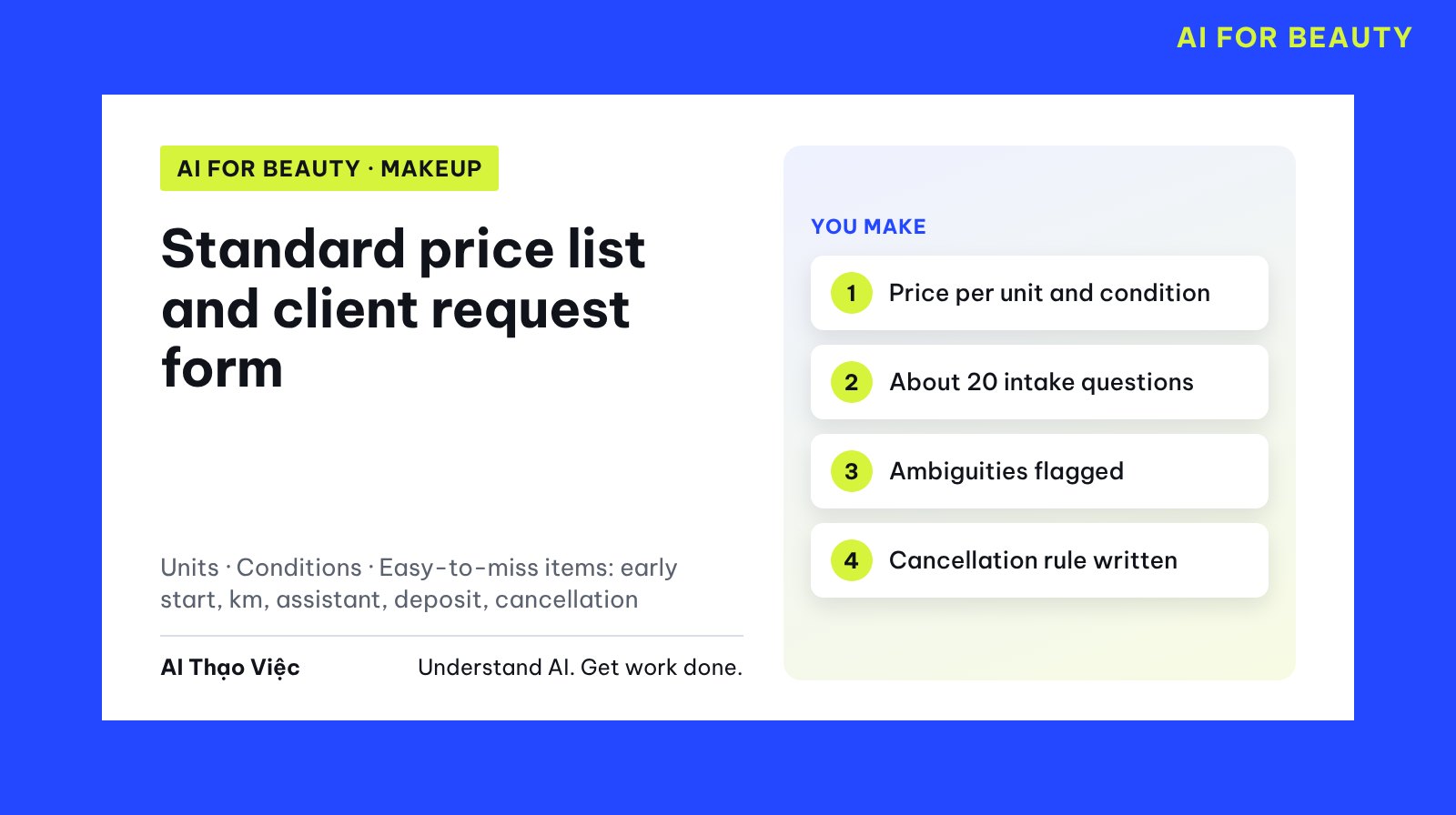
The task and the outputs
- Standard price list: item, unit price, unit (person, session, km), conditions, status: clear or needs a decision.
- Request form: the questions you must have answers to before you quote.
- A list of items that are missing or contradictory, each with the reason it could make a quote wrong.
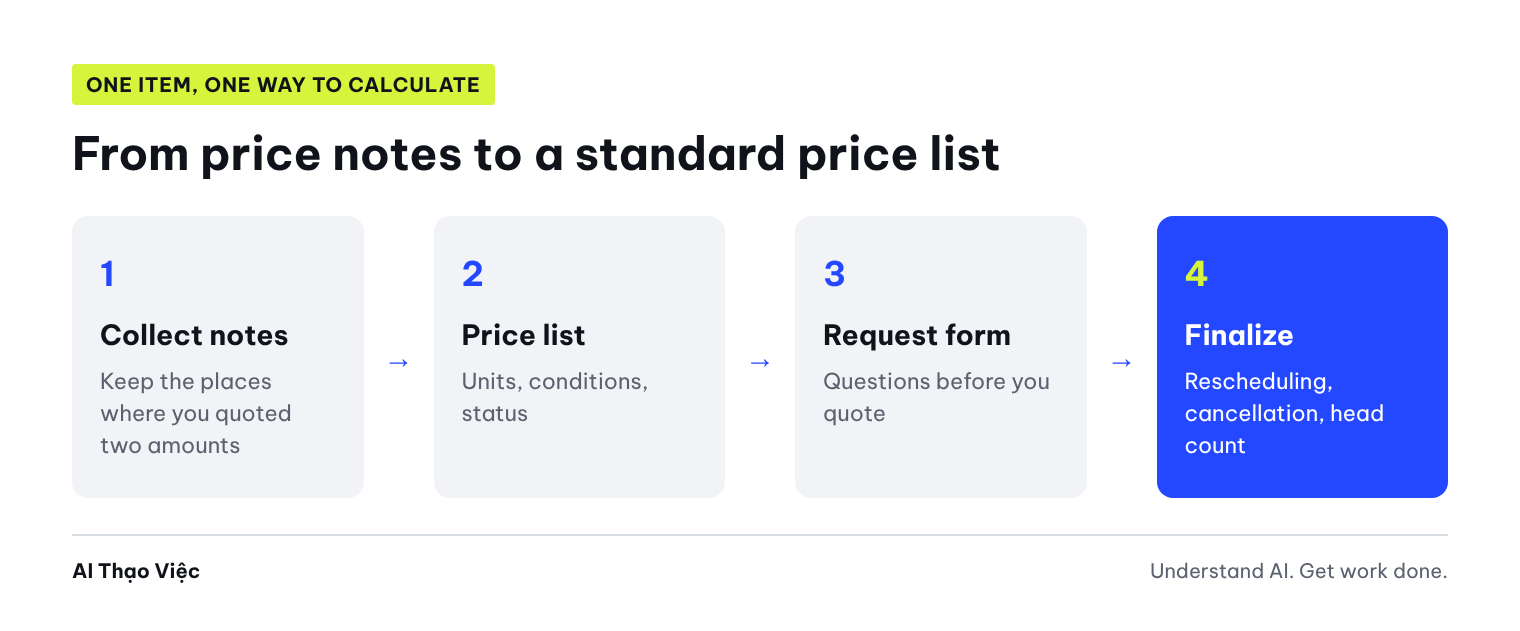
Step 1: collect your price notes as they are
Collect your recent quote messages, the price list on your social profile, your notebook. Remove client names and phone numbers. Keep the places where you once quoted two different amounts. Simulated notes used in the test:
Bridal makeup 1,500k including hair, one touch-up within the first 2 hours. Family makeup 400k/person, hair extra 150k. Event or yearbook makeup 350k.
Before 6am surcharge 200k (the last few times I charged 150k).
Travel: free within 10km, beyond 10km 10k/km one way.
Assistant: 300k/session, required for 4 people or more.
30% deposit to hold the date. Reschedule with 7 days notice keeps the deposit, under 7 days loses the deposit.
Standard false lashes included, premium lashes extra.
Staying for the whole event: negotiable.
Step 2: ask AI to standardize
You are helping a freelance makeup artist standardize her price list and client request form.
THE ARTIST'S NOTES (verbatim): [paste].
TASKS:
1. STANDARD PRICE LIST: item | unit price | unit | conditions | status (clear / artist must decide).
2. REQUEST FORM: the questions to ask the client in order to quote correctly (date, start time, location, number of people, who needs hair...).
3. LIST OF MISSING OR CONTRADICTORY ITEMS in the notes, each with the reason it could make a quote wrong.
Do not set any new price, surcharge or term yourself. Do not write promotional copy about the artist's experience.
Results from the test run
Tổ Thạo Việc (the AI Thạo Việc editorial team) ran it on 2 Oct 2026 in ChatGPT web, temporary chat, Medium level.
- A 16-row price list with units and status. It did not fill in prices for premium lashes or staying for the event.
- A request form of about 20 questions: date, start time, time it must be finished, address, number of people, how many need hair, lash type, distance, whether to stay for the event, whether the date can change.
- It caught every planted ambiguity, including the ones most likely to cause disputes:
- early surcharge 200k or 150k, per person, per session or per booking; whether exactly 6:00 counts;
- where travel is measured from; beyond 10 km, is the whole distance charged or only the excess (15 km could be read as 15 or 5 km);
- whether "from 4 people" includes the bride;
- whether the 30% deposit is on makeup only or also hair, assistant and travel;
- whether exactly 7 days notice falls in the keep-deposit or lose-deposit group;
- the notes only cover rescheduling, with no rule for a full cancellation; AI advised not to apply a lost deposit on its own;
- whether "touch-up within the first 2 hours" counts from the start, the finish or the start of the event;
- whether event and yearbook makeup includes hair; whether standard lashes are already in the price.
The AI's error: in the sentence about the deposit, AI inserted a stray Hebrew word in the middle of the Vietnamese sentence. A small error, but very unprofessional if pasted straight into a message to a client. Always reread the full text before using it.
Step 3: finalize the price list
- Choose one amount for each item and one way to calculate it: for example "surcharge 200,000 VND/session if the start time is before 6:00"; "the distance beyond 10 km, one way from the artist's home".
- Define how people are counted: "4 or more people having makeup, including the bride".
- Write all three cases: rescheduling with enough notice, rescheduling at short notice, cancellation.
- Mark separately quoted items (premium lashes, staying for the event) as "not included in the total" so they are not read as free.
- Put the request form into Google Forms or a template message, and send it to the client before you quote.
Self-check
- Does every item have a unit and conditions?
- No item left with two prices?
- Is there a separate rule for cancellation, not just rescheduling?
- Does the request form ask for enough information to calculate every item in the list?
- Have you reread the full text, with no odd words or promotional lines AI added on its own?
Put it to use and hand it over
Save the finalized price list and note the date it takes effect. Update the old price list on your social profile the same day. If you work as a team, send the list and the form to everyone who takes bookings, so the whole team quotes the same way.
Next
Sources & notes
- OpenAI Help Center: Does ChatGPT tell the truth?: AI can give wrong or incomplete information, so the price list and terms must be reread and finalized by the professional. Checked 2 Oct 2026.
- The price notes are simulated; the prompt was run once on ChatGPT. No commercial relationship with the sources above.