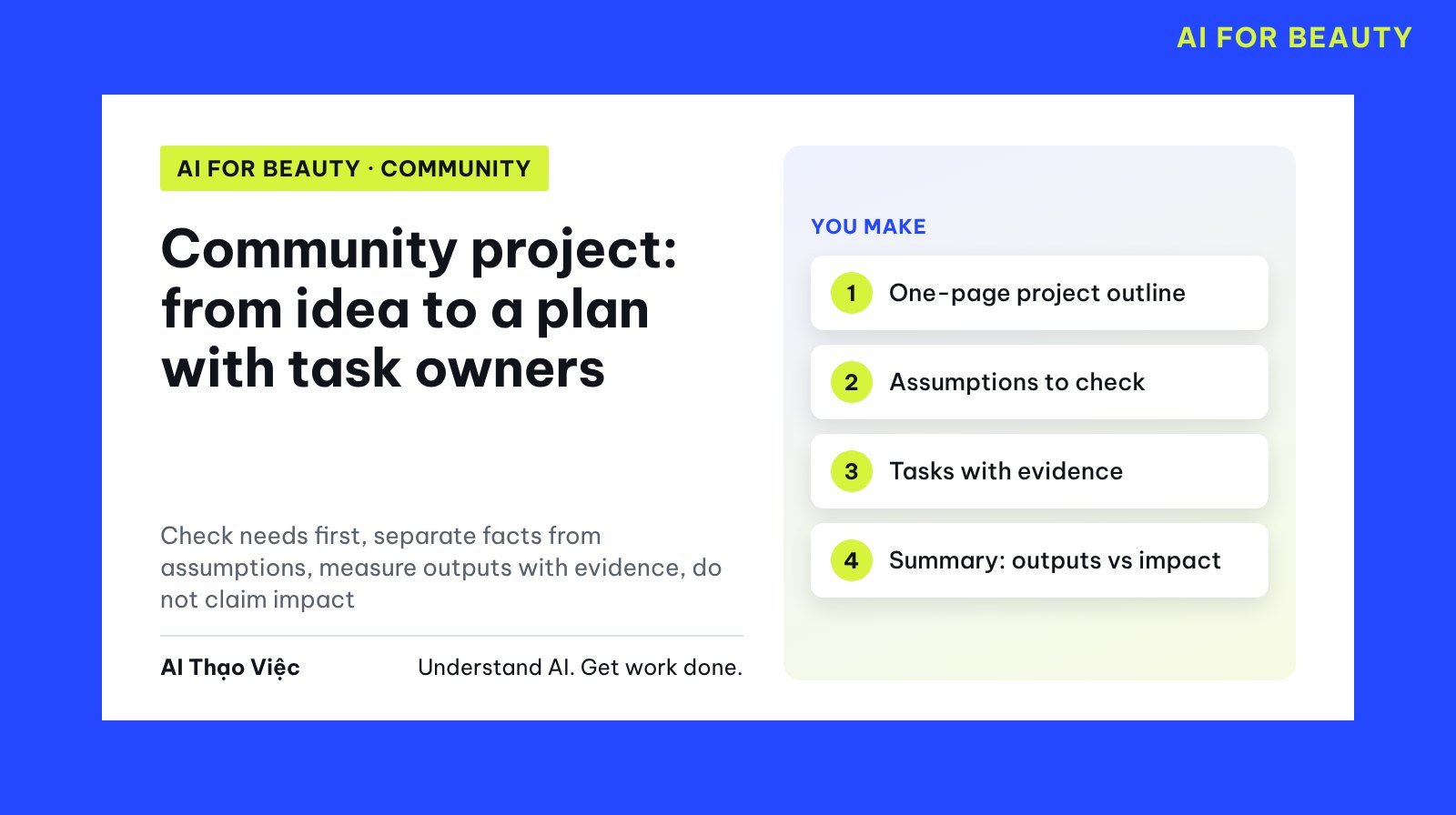
You are a pageant titleholder, the ambassador of a contest or part of a small community group, and you want to run a social activity with a local partner. This article takes you from an idea to a usable pilot plan: a one-page outline, a table of assumptions to check, a task table with owners and evidence of completion, a way to record results after the session, and an introduction message to the partner.
This is a planning method. It does not promise that the project will succeed or create impact. AI helps you separate what you know from what you are guessing, and it writes drafts. AI must not name partners, beneficiaries or results for you. The example in this article is simulated: a session on presence and poise for job and scholarship interviews for grade 12 students at "Thư viện phường A" (a fictional ward library).
A few terms used here
- Prompt (the request you type to the AI): the text you paste into a text AI assistant such as ChatGPT, Claude or Gemini. You can copy the "Prompt" blocks word for word.
- Project outline: one page that states the problem, the people served, the activities, the outputs, what is still unknown and who is in charge.
- Assumption: something the group believes is true but nobody has confirmed, for example "the library will lend us a room".
- Pilot: doing something once on a small scale to test the approach before expanding.
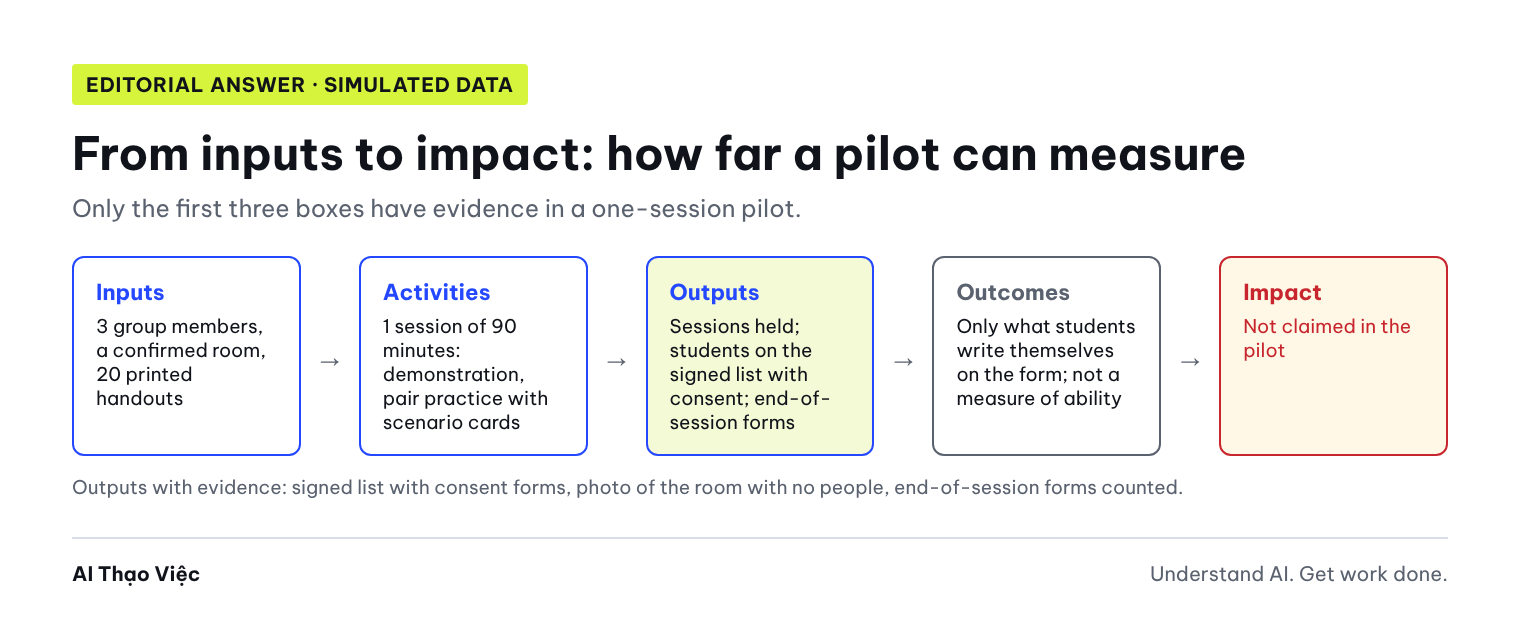
- Logic model: the chain of inputs, activities, outputs, outcomes and impact.
- Output: the products or services delivered, which can be counted, for example the number of sessions or the number of participants on a sign-in list. Outcome: a change in the participants. Impact: a longer-term, broader change.
- Evidence of completion: something that shows other people a task is done, for example a message confirming the room or a signed attendance list.
Prepare sources and remove private details
Gather your notes from every conversation with the people you plan to serve and with partners, with dates. Mark clearly which sentences are their own words and which are the group's interpretation.
- Do not paste the names, phone numbers, schools or classes of students or contacts into AI. Use roles instead: "librarian", "homeroom teacher", "S1".
- Do not use AI-generated images or photos from other activities as photos of this project. A fictional image is never evidence of community activity.
- Grade 12 students are usually 17 to 18 years old, and many are minors. The Law on Personal Data Protection No. 91/2025/QH15 (Luật Bảo vệ dữ liệu cá nhân) has separate provisions on children's data; this article does not conclude which provisions apply to this age group. The careful approach: get written consent from the student and a parent or guardian before taking photos, keeping a name list or publishing anything; ask someone with legal expertise about the consent form. This is not legal advice.
Step 1. Write down what you already have
The simulated data below deliberately contains three traps to test the AI: a target with no basis, a contradiction between the librarian's words and a group note, and a rumor about gifts.
GROUP NOTES (SIMULATED, 31 Oct)
Group: Ngọc Hân (ambassador of a simulated beauty pageant), Bảo Vy, Khánh Linh.
Idea: a session on presence and poise for interviews (introducing yourself, answering questions, preparing neat clothing) for grade 12 students.
Target someone wrote in the group chat: "help 500 students feel more confident".

CONVERSATIONS SO FAR
28 Oct: Hân talked with the librarian at Thư viện phường A (Ward A Library, a simulated partner). The librarian said: "The activity room has about 30 seats and is usually free on Saturday afternoons. I have to ask the library management first."
29 Oct: Hân asked 4 grade 12 students she knows. 3 want to learn how to answer interviews for scholarships or part-time jobs. 1 wants to learn party makeup.
Bảo Vy's note in the group chat: "The library already agreed, and they will help us promote it too."
Khánh Linh heard that "Brand A may give the students gifts". Nobody has contacted Brand A.

CONFIRMED RESOURCES
3 group members, each about 4 hours per week for 4 weeks.
Bảo Vy can print 20 copies of handouts herself. Hân has her own set of interview practice scenario cards.

TIMING: want to hold it on a Saturday afternoon in November.

UNKNOWN: whether the room is confirmed; whether the ward or school needs to be informed; how many students really want to come; who will tell the students.
Step 2. Separate facts from assumptions
Help my group prepare a small community project. Use only the notes I paste below.
Task 1: sort all information into three groups: Facts (someone said it or it is in the notes; give the date and who said it), Assumptions (the group believes it but nobody has confirmed it), Contradictions (two sources say different things).
Task 2: build a table of assumptions to check, 4 columns: Assumption | Who to ask | How to confirm (what evidence) | Deadline.
Rules:
Do not add partner names, beneficiaries, numbers or commitments that are not in the notes.
When two sources contradict each other, do not pick a side; record both and put the item in the assumptions table.
Mark any numeric target without a basis as "no basis yet".
If money or in-kind gifts come up, write only "needs a separate transparent process and a person responsible for finances", with no further guidance.
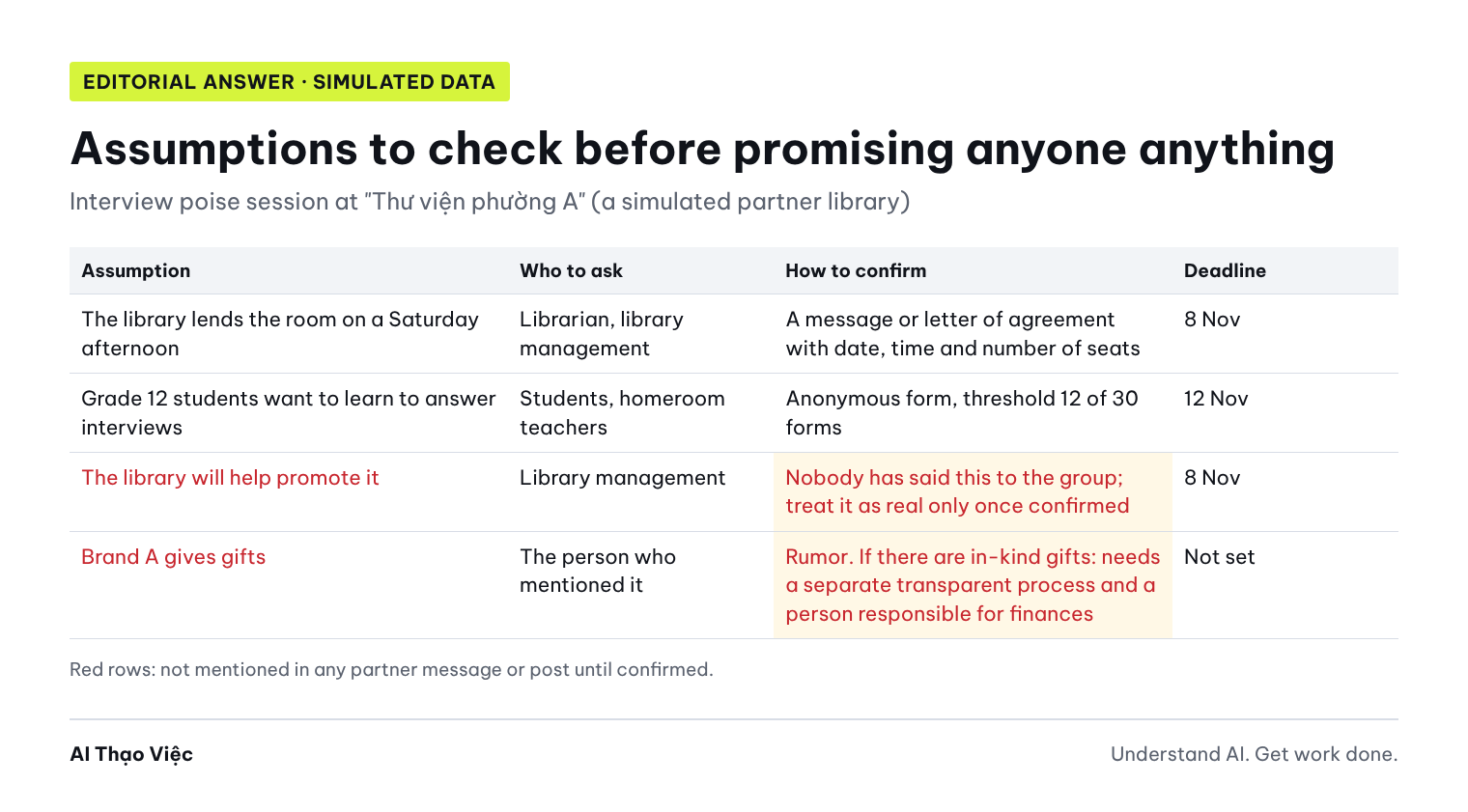
Editorial answer (written by the editors, not run on a real tool). Facts: the librarian's words on 28 Oct (room of about 30 seats, needs to ask management); 3 of the 4 students asked want to learn to answer interviews; resources of three people and 20 printed copies. Contradiction: Bảo Vy wrote "the library already agreed" while the librarian said management still had to be asked. No basis yet: "500 students" and "feel more confident". Assumptions table:
| Assumption | Who to ask | How to confirm | Deadline |
|---|---|---|---|
| The library lends us a room on a Saturday afternoon | Librarian, library management | A message or letter of agreement with date, time and number of seats | 8 Nov |
| The library helps promote the session | Library management | Nobody has said this to the group; treat it as real only once confirmed | 8 Nov |
| Grade 12 students around the ward want to learn to answer interviews | Students, homeroom teachers | Anonymous needs form in step 3 | 12 Nov |
| There is a channel to reach students | Homeroom teachers, the library | The person who owns the channel agrees to pass on the message | 12 Nov |
| No need to inform the ward or school | The library, the ward culture officer | A recorded answer, with date | 8 Nov |
| Brand A gives gifts | Khánh Linh (who heard the news) | Rumor. If there are in-kind gifts: needs a separate transparent process and a person responsible for finances | Not set |
To stress-test the plan further, use the reverse-questioning approach from the article asking AI to challenge your plan before you act (in Vietnamese) on each assumption row.
Step 3. Check needs with the people you serve
Four students you know are not enough to tell you the need, and one of them already wants a different topic. Before promising anything to anyone, run a small test: an anonymous form handed out through homeroom teachers or left at the library desk. Set your decision threshold before you hand out the forms.
Write a needs form for grade 12 students, at most 5 questions, answerable in 2 minutes.
Do not ask for full name, phone number, school, class or photos.
Questions must not be leading and must not assume the students lack confidence.
Include one question to choose a topic: answering interview questions, introducing yourself, neat clothing for interviews, other topic (write in).
Include one question: would you like to join a 90-minute session on a Saturday afternoon (yes / no / not sure).
At the end of the form write: this form is anonymous and is only used for the group to decide whether to hold the session.
Editorial answer: five questions (which grade, topic you want to learn, have you ever had an interview, would you join a 90-minute Saturday afternoon session, comments), with no name field. Threshold the group sets for itself: hand out 30 forms (printed separately, on top of the 20 copies printed for the session; printing and handing out are listed in the task table in step 5); if at least 12 forms choose "yes", run the pilot; below 12, change the time or the topic and ask again. The number 12 is the group's decision, not a general standard.
Step 4. One-page outline and pilot plan
From the notes and the assumptions table, write a one-page project outline with:
Problem (in the words the people served actually used) | People served | Pilot activity | Measurable outputs and evidence | Unknowns | Partners and confirmation status | Overall lead.
Then write the pilot plan: 1 session of 90 minutes, at most 20 students, split into time blocks with the tasks for each part.
Write "still asking" for any unconfirmed partner. Do not write targets about the number of beneficiaries or confidence levels.
Do not include gifts, sponsorship or donations in the plan.
Editorial answer, pilot plan part: 15 minutes for introductions and stating the purpose of the session; 20 minutes of Hân demonstrating a self-introduction and answers to three common interview questions; 35 minutes of pair practice with scenario cards while the three group members walk around giving feedback; 10 minutes of tips on neat clothing for interviews, with no comments on any student's appearance; 10 minutes for the end-of-session form. Total 15 + 20 + 35 + 10 + 10 = 90 minutes. The limit is 20 students because there are 20 printed copies and the room has about 30 seats. The partner line reads "Thư viện phường A: still asking". Ideas for practice content: scenario cards for practicing communication and poise (in Vietnamese).
Step 5. Assign tasks: task, owner, deadline, evidence
Build a task table for the pilot, 4 columns: Task | Owner | Deadline | Evidence of completion.
Only write Hân, Bảo Vy or Khánh Linh as the owner when the notes show that person has taken on or already done related work; otherwise write "no owner yet".
Evidence must be something other people can see (a message, a list, a file), not "done".
Deadlines must be before the event date and match the assumptions table.
Editorial answer:
| Task | Owner | Deadline | Evidence of completion |
|---|---|---|---|
| Get confirmation of the room, date, time and seats | Hân | 8 Nov | A message or letter from the library |
| Print 20 copies of handouts and scenario cards | Bảo Vy | 2 days before the session | Photo of the printed stack, with no faces |
| Print 30 needs forms, hand them out and count them | No owner yet | 12 Nov | A tally of forms by question |
| Consent form for students and parents or guardians | No owner yet | Before taking registrations | Form template reviewed by someone with expertise |
| Ask whether the ward or school must be informed | No owner yet | 8 Nov | A recorded answer, with date and who answered |
| Signed attendance list at the session | No owner yet | Event day | Signed list, kept within the group only, not posted |
The notes do not show Khánh Linh taking on any task, so the AI does not assign anything to Linh on its own. The four "no owner yet" tasks are for the group to divide at its next meeting, with each person confirming for themselves. How to turn group meeting notes into a task table: meeting notes into a task table (in Vietnamese).
Step 6. Introduction message to a partner
Write a short message from Hân to the management of Thư viện phường A asking to borrow a room.
State only: who the group is, what the session does, who it is for, the planned date and time, number of seats, what the group will handle itself, and what the group asks of the library.
Ask clearly whether the library agrees to lend the room and whether any procedure is needed.
Do not write that the library has agreed, do not ask the library to promote it, do not mention gifts or brands.
Do not promise numbers of beneficiaries or results.
Editorial answer (excerpt): "We are a group of three and would like to hold a free 90-minute session to practice introducing yourself and answering interview questions for up to 20 grade 12 students, on a Saturday afternoon in November. Our group will handle the content and printed materials. We would like to borrow the activity room. Would the library agree, and what procedure is needed?" How to write clear work messages: writing work emails (in Vietnamese).
Step 7. Record results after the session
In the logic model breakdown, outputs are the products and services delivered; outcomes are changes that happen over time in the short, medium and long term. A single pilot session only gives you evidence of outputs and of what participants write down themselves right after the session.
AFTER THE SESSION (SIMULATED)
Sessions held: 1.
Signed attendance list: 18 students, all with consent forms from the student and a parent or guardian.
End-of-session forms returned: 15.
Of the 15 forms, 12 students chose "I learned at least one more way to introduce myself".
Photos: the room photographed before the session, with no students in it.
Write a pilot summary from the figures pasted above, in 3 parts:
Outputs delivered: only countable figures, with evidence.
Short-term outcomes: only what participants wrote themselves on the forms; state that the denominator is the number of forms returned and say clearly that this is self-assessment.
Long-term impact: write "not claimed in the pilot".
Show the calculation. Do not use the words "more confident", and do not infer results for people who did not return a form.
Finally, list what to change if you hold a second session.
Editorial answer: outputs are 1 session and 18 students named on the signed list, all with consent forms. Short-term outcome: 12 of the 15 forms returned, that is 12 ÷ 15 = 80% of forms, say they learned at least one more way to introduce themselves; this is self-assessment, and 3 students did not return a form, so their answer is unknown. Impact: not claimed in the pilot.
Spot wrong output
- Invented beneficiaries and results: the outline says "the project helps 500 students feel more confident". The number has no basis; "more confident" cannot be measured in one session.
- Picking a side when two sources contradict: the message to the partner says "thank you to the library for agreeing to partner with us and promote the session". The librarian only said management had to be asked.
- Turning a rumor into a commitment: the plan has a line "Brand A sponsors 20 gift sets". Nobody has contacted Brand A.
- Wrong denominator: the summary says "12/18 = 67% of students more confident". The correct denominator is the 15 forms returned, and it is self-assessment.
- Suggesting illustrative images: "use AI images of smiling students for the summary post". Fictional images must not be used as photos of a real activity.
- Adding a donation appeal: the AI adds a post calling for support. This article does not set up a fundraising campaign.
The last version goes beyond the data in places. Fix it as follows:
1. Remove "500 students" and "more confident"; write the people served as "up to 20 grade 12 students in the pilot session".
2. Write the library as "still asking"; remove every sentence saying the library has agreed or will help promote.
3. Remove the Brand A and gifts line; if there are in-kind gifts, write "needs a separate transparent process and a person responsible for finances".
4. Recalculate the rate on the 15 forms returned, and label it self-assessment.
5. Remove the suggestion to use AI images and the donation appeal post.
List each sentence you changed and why, then return the full version.
Use it with your own data
- Write down every conversation with the people you serve and with partners: date, who said it, what they said. Separate their words from the group's interpretation.
- Remove names, phone numbers, schools and classes; replace them with roles. Do not paste photos of participants.
- Run Prompt 1, then take the assumptions table to each person and ask. Until you have confirmation, do not promise anything to anyone.
- Run the needs test with a threshold set in advance. If you do not reach the threshold, change the design, not the threshold.
- Write the outline, the task assignments and the message to the partner. Each person rereads the tasks with their name and confirms they accept them.
- Final reviewers: the group leader together with a partner representative. If money or in-kind gifts are involved, you need a separate transparent process and a person responsible for finances before accepting anything.
Suggested use in a meeting of an ambassador group or club: each group writes a one-page outline and a needs test for its own idea; every simulated partner must be clearly marked "simulated" on paper; groups swap assumptions tables to find rows that still lack a way to confirm.
Check before you use it
- Every partner in the outline has a status: confirmed (with evidence) or still asking.
- No number of beneficiaries or results lacks a basis.
- The need has been checked with the people served themselves, with a threshold set in advance.
- Every task has an owner who agreed, a deadline and evidence of completion; tasks nobody has taken are clearly marked.
- Countable outputs are separated from self-assessed outcomes; impact is not claimed.
- There are consent forms from students and parents or guardians before making a name list or taking photos.
- No AI images or photos from other activities are used as project photos.
- No donation appeals, sponsorship commitments or financial figures.
- The message to the partner does not say on the partner's behalf anything they have not said.
When things go wrong
- The partner has not replied close to the deadline: push back the date and do not post an announcement. You can ask another venue and record it as a backup option.
- The needs forms do not reach the threshold: look at the topic question, change the time or content and ask again; do not hold the session just because the group has already prepared.
- Someone wants to give money or gifts: thank them and do not accept yet; write "needs a separate transparent process and a person responsible for finances" and discuss it separately.
- A member does not do the task they took on: look at the task table, ask directly whether you need to change the owner or push back the deadline; update the table.
- You want to post after the session: use only real photos with consent; a photo of the empty room is a safe choice. State the figures exactly as in the summary.
Limits and sources
The group, the notes, Thư viện phường A, Brand A and all figures in this article were written by Tổ Thạo Việc (the AI Thạo Việc editorial team) using simulated data. The prompts have not been run on an AI tool; the "Editorial answer" parts are the expected output written by the editors. This article does not give guidance on fundraising, sponsorship or administrative procedures. The personal data section only lists what you should ask about and is not legal advice; ask someone with expertise before collecting data, taking photos or publishing.
- University of Saskatchewan, Logic Models for Program Evaluation: Purpose and Parts: defines inputs, activities, outputs (products and services delivered) and short, medium and long-term outcomes.
- BetterEvaluation, Develop programme theory / theory of change: the chain of inputs, processes, outputs, outcomes and impact; it can be built together with the community and used to see where evidence is still missing.
- Can Tho City legal education portal (Cổng phổ biến giáo dục pháp luật TP Cần Thơ), summary of the rules on protecting children's personal data (in Vietnamese) under the Law on Personal Data Protection No. 91/2025/QH15 (Luật Bảo vệ dữ liệu cá nhân), in effect from 1 Jan 2026. This article cites it only to show that the law has separate provisions for children, and does not conclude that those provisions apply to students aged 17 to 18.
- PwC Vietnam, New rules on personal data protection (Quy định mới về bảo vệ dữ liệu cá nhân): Decree 356/2025/NĐ-CP (Nghị định, government decree on personal data protection) takes effect from 1 Jan 2026, replacing Decree 13/2023/NĐ-CP, which many older documents still cite.
Sources checked on 31 Oct 2026. Read next: finding a brand story in real material (in Vietnamese) (when you want to tell the story of the project, use only real material) and the foundation article in the same series, AI for Beauty: where to start.