You teach makeup, hair or nails and already have your own routine. This article shows how to ask AI to lay out that routine as two things you can use right away in a practice session: a practice sheet for students and a rubric for the trainer. The trainer writes the criteria and is responsible for them; AI only arranges them, points out gaps and calculates time.
This is one way of working, not a promise that students will build skill faster. AI does not look at photos to assess skill, and does not comment on the appearance of practice models or students. The example uses a natural foundation application; the method also works for hair or nail lessons that have an approved routine.
A few terms used here
- Prompt: the text you paste into a text AI assistant such as ChatGPT, Claude or Gemini. The "Prompt" blocks in this article can be copied word for word.
- Practice sheet: the sheet students hold while working, listing steps, time, evidence they must show, errors that require a redo, and self-explanation questions.
- Rubric: a table that breaks the work into parts and describes each part at each level. Here there are three levels: Pass, Redo, Not observed.
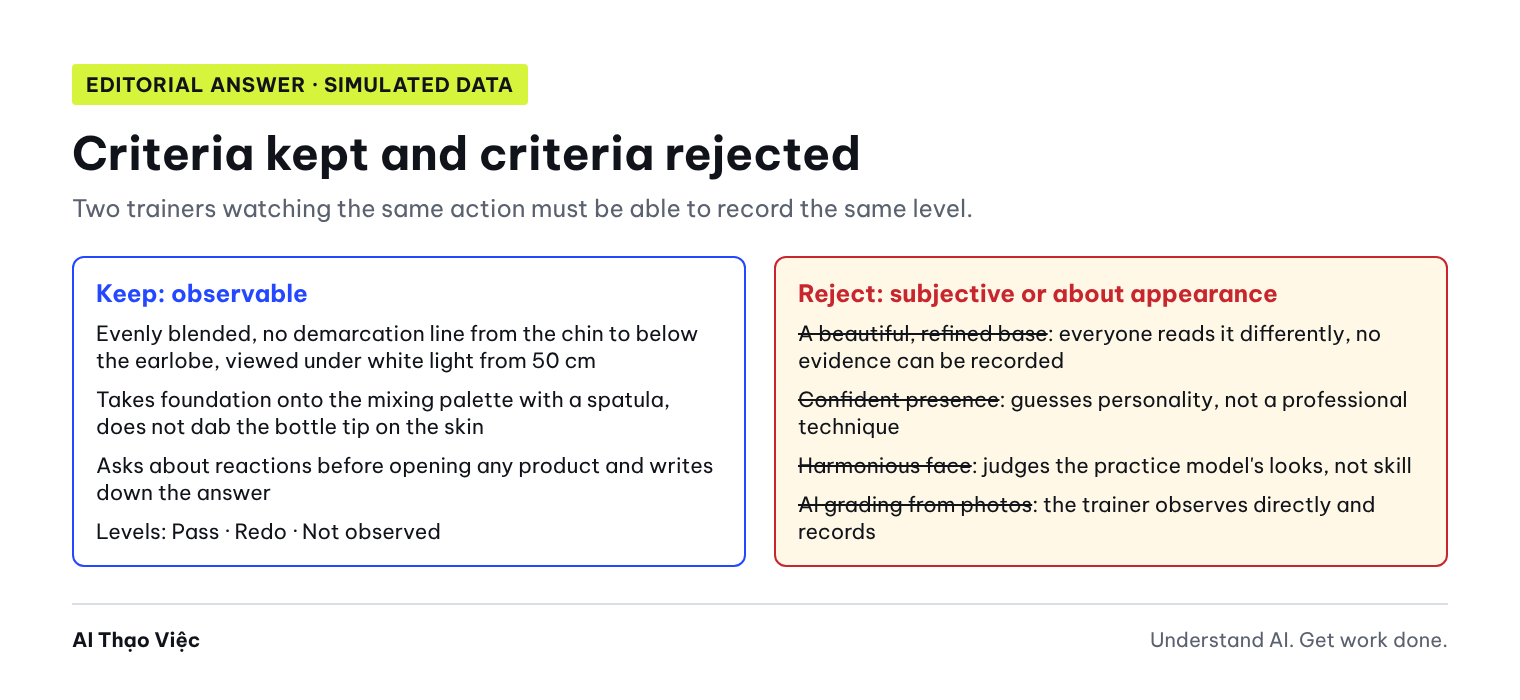
- Observable criterion: a description that someone else watching the same work would record the same way you do. "Evenly blended, no visible demarcation line along the jawline" is observable; "a beautiful, refined base" is not.
- Evidence: something the trainer sees or hears on the spot, for example the student using a spatula to take foundation out onto a mixing palette.
- Independent assessment: two trainers assess the same scenario without discussing it first, then compare results to fix the wording of the criteria.
Prepare your source and remove private details
Gather four things: the session goal, a routine confirmed by you or your school's specialist, a tool list, and the errors students often make. Write the criteria in your own words before you open the AI.
- Replace student and practice model names with codes (ST01, M01). Do not paste phone numbers, training contracts or tuition fees.
- Do not give the AI photos of the faces or hands of students or practice models. Photos of other people who have not agreed should not go anywhere at all.
- If nobody has approved the routine yet, mark it clearly as a "draft" and do not use it for a class.
Step 1. The trainer writes the session outline and criteria
The data set below is simulated. This is a sample routine written by the editors for illustration, not a professional standard; use a routine confirmed by your own trainer or specialist. The data set deliberately contains three things to test the AI: step 7 has no criterion, the total time of the steps exceeds the practice slot, and there is one teaching assistant's note that has not been approved.
SESSION (SIMULATED)
Trainer: Minh Thư. Basic makeup class, 6 students (ST01 to ST06).
Goal: students apply a natural foundation on a practice model by themselves, following the class routine.
Length: 90 minutes. Theory and demonstration 35 minutes, practice 45 minutes, wrap-up 10 minutes.
Note: sample routine written by the editors for illustration, not a professional standard.

APPROVED ROUTINE (step, time)
S1. Wash hands, disinfect tools, lay them out on a clean tray (5 minutes)
S2. Ask the practice model whether they have ever reacted to any product. If yes, do not use that product and tell the trainer (3 minutes)
S3. Clean the skin with cotton and the class makeup remover, apply a thin layer of moisturizer (7 minutes)
S4. Test 2 foundation shades on the jawline under white light, choose the shade closest to the neck color (5 minutes)
S5. Take foundation out onto the mixing palette with a spatula, dot 5 points: forehead, both cheeks, nose, chin (3 minutes)
S6. Blend with a damp sponge from the center of the face outward, carefully at the jawline, hairline and sides of the nose (15 minutes)
S7. Set the foundation with a thin layer of setting powder on the T-zone (5 minutes)
S8. Put used sponges in the dirty tray, wipe brushes, clear the tray (7 minutes)

TOOLS: foundation sponge, powder brush, plastic spatula, mixing palette, clean tray, dirty tray, cotton, makeup remover, moisturizer, 2 foundation shades, setting powder, white light.

CRITERIA CONFIRMED BY THE TRAINER
CR1 (S1): washes hands before touching tools; tools are on a clean tray, not placed on the bare table.
CR2 (S2): asks about reactions before opening any product; writes the answer on the sheet.
CR3 (S3): waits at least 2 minutes after applying moisturizer before applying foundation.
CR4 (S4): tests exactly 2 shades on the jawline, not on the back of the hand; can say why the shade was chosen.
CR5 (S5): takes foundation out onto the mixing palette with a spatula; does not dab the bottle tip on the skin.
CR6 (S6): evenly blended, no visible demarcation line at the jawline and hairline when viewed under white light from 50 cm; no foundation buildup at the sides of the nose.
CR7 (S8): used sponges are in the dirty tray; brushes are wiped before being put away.

COMMON ERRORS: dabbing the bottle tip on the skin; testing shades on the back of the hand; visible line at the jawline; foundation buildup at the sides of the nose; forgetting to ask about reactions; leaving used sponges on the clean tray.

TEACHING ASSISTANT'S NOTE (NOT YET APPROVED BY THE TRAINER): we should add the criteria "a beautiful, refined base" and "the practice model looks fresh".
Step 2. Ask AI to lay it out as a practice sheet
Open a new chat, paste the prompt below, then paste the data block from step 1 right after it.
Help me, a makeup trainer, lay out an approved routine as a practice sheet for students.
Use only the data I paste below. Do not add steps, do not add criteria, do not change times.
Build a 5-column table: Step | Time | Evidence that must be shown | Redo when | Self-explanation question.
The "Evidence that must be shown" column takes the exact wording of the matching CR criterion, with the CR code.
The "Redo when" column comes from the common errors list; if a step has no matching error, write "not yet written by the trainer".
Each self-explanation question asks for the reason behind one action, not for feelings.
If a step has no criterion, write exactly "trainer has not provided a criterion", and do not write one yourself.
Any note not approved by the trainer: do not put it on the sheet; list it separately at the end.
Do not assess, and do not comment on the appearance of practice models or students.
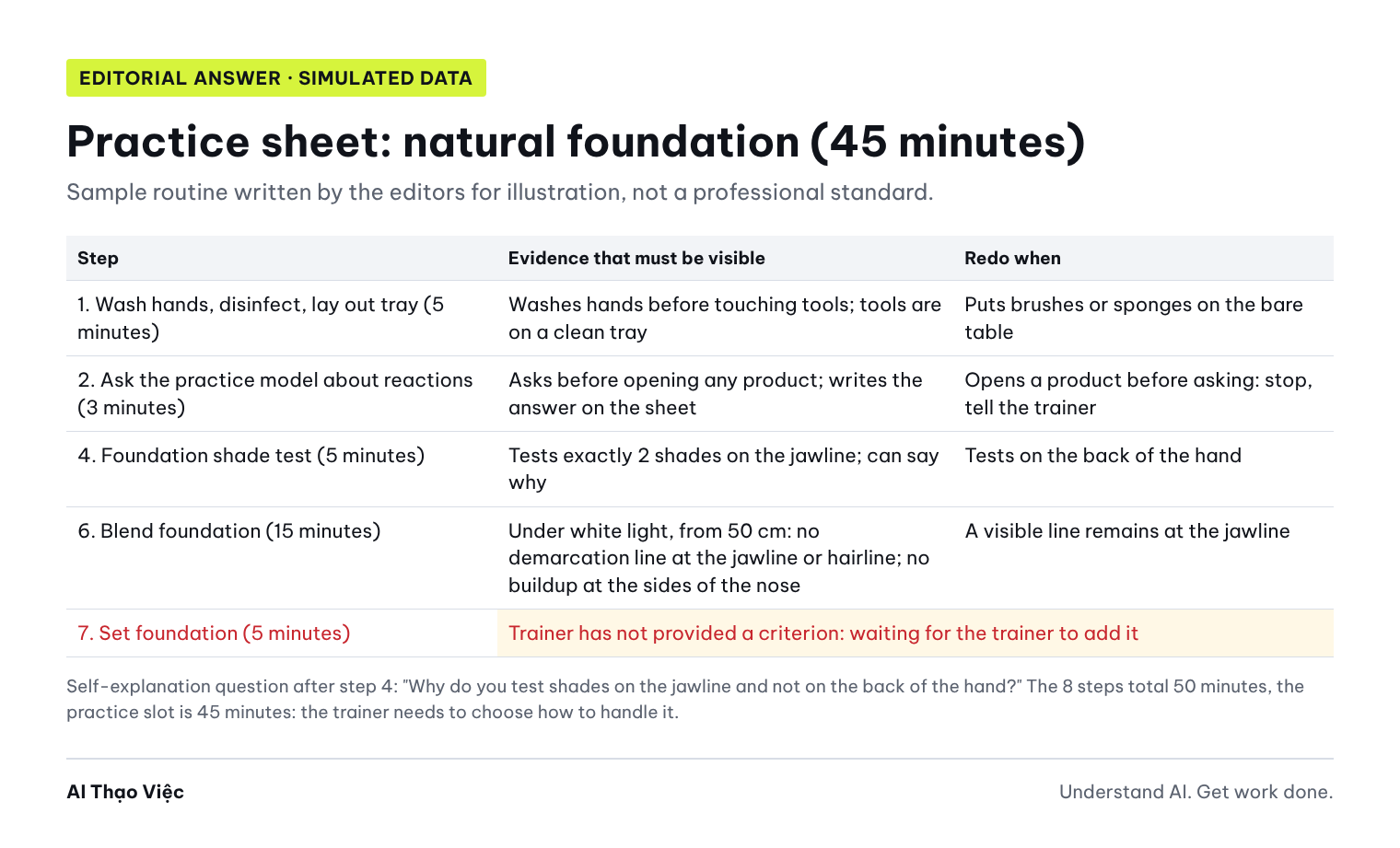
Editorial answer (written by the editors, not run on a real tool). The table has all 8 rows; below are the rows with points to check:
| Step | Time | Evidence that must be shown | Redo when | Self-explanation question |
|---|---|---|---|---|
| S2. Ask about reactions | 3 minutes | CR2: asks before opening any product; writes down the answer | Forgets to ask about reactions (stop, tell the trainer) | Why must you ask before opening any product? |
| S3. Cleanse, moisturize | 7 minutes | CR3: waits at least 2 minutes after moisturizer | Not yet written by the trainer | What happens if you apply foundation while the moisturizer is still wet? |
| S4. Shade test | 5 minutes | CR4: 2 shades on the jawline; can say why | Tests shades on the back of the hand | Why test on the jawline and not on the back of the hand? |
| S6. Blend foundation | 15 minutes | CR6: no line at the jawline or hairline under white light from 50 cm; no buildup at the sides of the nose | Visible line at the jawline; foundation buildup at the sides of the nose | Why blend from the center of the face outward? |
| S7. Set foundation | 5 minutes | Trainer has not provided a criterion | Not yet written by the trainer | Waiting for the trainer to add it |
At the end of the table, the AI must list separately: "Teaching assistant's note not yet approved: a beautiful, refined base; the practice model looks fresh. Not included on the sheet." The sheet as an image:
Step 3. Ask AI to build a three-level rubric
The sheet is for students. The rubric is for the trainer, to use while walking around the class. The "Not observed" level matters: while you are standing at ST02's table, you cannot see how ST05 takes out foundation, and you must not guess.
From criteria CR1 to CR7 that I pasted, build a rubric for the trainer.
One row per criterion. Columns: CR code | Step | Pass when | Redo when | Not observed | Observation notes.
"Pass when" copies the criterion exactly. "Redo when" describes an action that can be seen but is missing something or wrong compared with the criterion.
The "Not observed" column always says: the assessor did not see this action; do not infer Pass or Redo.
Do not add new criteria. Do not add a score column.
After the table, for each criterion, say whether two people watching the same action could easily record it differently, and because of which word; only suggest wording, and leave the decision to the trainer.
Editorial answer, three rows shown:
| Code | Pass when | Redo when | Not observed |
|---|---|---|---|
| CR2 | Asks about reactions before opening any product and writes down the answer | Opens a product before asking, or asks without writing it down. Stop the work and tell the trainer | The assessor was not there when the student started |
| CR5 | Uses a spatula to take foundation out onto the mixing palette | Dabs the bottle tip on the skin, even once | Did not see the foundation being taken out |
| CR6 | No line at the jawline or hairline under white light from 50 cm; no buildup at the sides of the nose | A demarcation line or foundation buildup at the sides of the nose is visible | Not yet checked under white light |
The AI's suggestions should point out CR6: "jawline" does not say whether the area below the earlobe counts. That is where two assessors easily differ, and you will test it in step 5.
Step 4. Test the timing
If a correct sheet does not fit the time, students will skip the last step, usually cleaning the tools.
Add up the time of the 8 steps in the routine I pasted. Compare it with the 45-minute practice slot.
Write out the full sum. If the total exceeds the slot, state how many minutes over.
Give at most 3 options for handling it; for each, note the steps affected and what the trainer needs to decide.
Do not choose an option yourself. Do not shorten the time of an approved step yourself.
Editorial answer: 5 + 3 + 7 + 5 + 3 + 15 + 5 + 7 = 50 minutes, which is 5 minutes over the 45-minute slot. Three options for Minh Thư to choose from: (a) students do S1 before the practice time, leaving 45 minutes, exactly the time for the other 7 steps; (b) cut theory from 35 to 30 minutes and raise practice to 50 minutes, so the session is still 90 minutes; (c) keep everything and move S7 to the next session, since S7 also has no criterion yet. The AI must not choose (c) on its own just because it is convenient.
Step 5. The trainer reviews and runs an independent assessment test
Before using it with a class, ask another trainer to assess the same scenario with you. Write the scenario in words, without photos. Each person fills in the rubric alone, without discussing it first.
SCENARIO (SIMULATED): ST03 applies foundation on practice model M03.
ST03 washes hands and lays the tools on a clean tray. Asks M03 about reactions, writes "none" on the sheet, then opens the products.
Applies moisturizer, waits about 3 minutes. Tests 2 shades on the jawline and says "I chose shade 2 because it is closest to the neck color".
Uses a spatula to take foundation out onto the mixing palette. After blending, under white light from 50 cm there is a faint line just below the left earlobe; the jawline toward the chin is even; the sides of the nose are clean.
Sets the foundation. At the end, the used sponge is left on the clean tray.

ASSESSOR A (Minh Thư): CR1 Pass; CR2 Pass; CR3 Pass; CR4 Pass; CR5 Pass; CR6 Redo; CR7 Not observed (was at ST05's table).
ASSESSOR B (Lan Chi): CR1 Pass; CR2 Pass; CR3 Pass; CR4 Pass; CR5 Pass; CR6 Pass; CR7 Redo.
Compare rubrics A and B for the same scenario above.
Build a table: CR code | A | B | Different or not | Possible reason.
Separate two kinds: differences because the criterion wording is unclear, and differences because one person did not observe.
For criteria that differ because of wording, suggest 1 rewritten criterion that is still observable.
Do not decide whether ST03 actually passed or needs a redo. Do not comment on the practice model's appearance.
Editorial answer: five criteria match. CR6 differs because of wording: A counts the area below the earlobe as the jawline, B does not. Suggested rewrite: "Evenly blended, no visible demarcation line from the chin to below the earlobe on both sides and at the hairline, viewed under white light from 50 cm; no foundation buildup at the sides of the nose." CR7 is not a criterion difference: A did not observe, B saw the sponge left on the clean tray. The CR7 result follows the person who saw it; A does not change to Pass. The two trainers agree on the new wording before printing the rubric.
This is also an exercise for a group of trainers: each person makes a sheet for a skill they teach, then two people independently assess a pre-written scenario and compare as above.
Spot wrong output
Compare the output with the data set in step 1. Errors to remove:
- AI adds subjective criteria: the rubric has rows like "confident presence", "harmonious face" or "a beautiful, refined base". The first two judge personality and appearance, not skill. The third is the teaching assistant's unapproved note, which the AI added on its own.
- AI fills in a criterion for S7 by itself: for example "thin layer of powder, not cakey". It sounds reasonable, but the trainer did not provide it, so it must say "trainer has not provided a criterion".
- AI cuts time by itself: shortens S6 from 15 to 10 minutes to fit the slot. Only the trainer can change approved times.
- AI offers to grade from photos: "send me photos of the students' work and I will assess the base". Refuse; the trainer observes directly and records.
- AI adds a 10-point score column: adding up points defeats the purpose of the "Redo" level at CR2, where the work must stop.
The sheet and rubric you just made do not follow the rules. Fix them as follows:
1. Remove every criterion without a code CR1 to CR7, including "confident presence", "harmonious face", "a beautiful, refined base".
2. For step S7 write "trainer has not provided a criterion" and delete the sentence you wrote yourself.
3. Return the step times to the exact approved numbers.
4. Remove the score column. Keep only three levels: Pass, Redo, Not observed.
5. Do not offer to grade from photos.
List every row you fixed and why, then return the full version.
Step 6. Use it in class and record observations
Hand out the sheets to students before practice time. The trainer holds the rubric, walks around the class and records the level plus one short observation, for example "CR6: faint line below the left earlobe". If you have not seen a criterion yet, leave it as "Not observed" and check again on the next round.
After the session, if you like, paste the observation notes (names replaced with codes) into the AI to group errors that many students repeat, and use that to choose what to demonstrate again next session. AI only counts and groups; deciding which students need to repeat is the trainer's job. To turn session content into practice sheets for home: see a 7-day practice sheet after class (in Vietnamese).
This article differs from observation sheets after a presence practice session (in Vietnamese): that one measures communication behavior, this one measures specific professional techniques. The layout of the observation table can be reused.
Use it with your own material
- Choose one skill from one session; do not combine the whole course.
- Copy the routine confirmed by you or your school's specialist. Write the confirmer's name and the date at the top of the document.
- Write a criterion for each step in your own words. Rewrite any sentence with words like "beautiful", "refined", "professional" or "confident" into something visible: position, viewing distance, lighting, tools.
- Replace the simulated data block from step 1 with your own data and run Prompts 1 to 3 in turn.
- Review each row against the original routine. Ask another trainer to independently assess a pre-written scenario (Prompt 4) and fix the wording.
- Try it with a small group before printing it for the whole class. The final reviewer is the trainer in charge of that skill.
Idea for a professional meeting of a trainer group: each person brings a routine, swap sheets, independently assess the same scenario and compare. The comparison usually reveals more wording to fix than the drafting does.
Check before you use it
- The routine on the sheet is the version confirmed by a trainer or specialist, with name and date.
- Each criterion has a code and matches exactly one step.
- No criteria remain about appearance, personality, "presence", "harmony" or "refinement".
- Steps without a criterion are clearly marked, not filled in by the AI.
- The total step time has been added up by hand and fits the practice slot, or the trainer has chosen an option.
- The rubric has a "Not observed" level and no score column.
- Safety criteria (asking about reactions, cleaning tools) clearly state when the work must stop.
- Two trainers have independently assessed a scenario and agreed on the wording.
- No real names or photos of students or practice models in anything pasted into the AI.
Troubleshooting
- The AI keeps adding criteria "to be complete": repeat "use only CR criteria with codes in the data", and ask it to list any suggestions outside the list separately so you can decide.
- Two assessors differ on many criteria: do not look for who is right; find which word in the criterion is vague (which area, where to look, what light) and rewrite it.
- Students cannot finish in time: look again at the timing table in step 4, record the actual minutes for a few students, then the trainer adjusts the slot.
- A student asks "what score did I get": explain the three levels and point to the missing evidence. This rubric is for practice and does not replace your school's certification exam.
- The practice model reports skin discomfort during the work: stop, tell the trainer and follow your school's safety rules. The sheet and the AI do not handle this situation.
Limits and sources
The foundation routine, criteria, scenario and two rubrics were written by Tổ Thạo Việc (the AI Thạo Việc editorial team) using simulated data for illustration; they are not a professional standard and have not been approved by a vocational trainer. The prompts have not been run on an AI tool; the "Editorial answer" parts are expected outputs written by the editors. This article does not replace your school's training program or assessment rules.
- Eberly Center, Carnegie Mellon University, Grading and performance rubrics: describes a rubric as a scoring tool that states expectations clearly, breaks the work into parts and describes each level; rubrics help keep grading consistent across multiple assessors.
- Can Tho City legal education portal (Cổng phổ biến giáo dục pháp luật TP Cần Thơ), Regulations on the national vocational skills qualification framework and national vocational skills standards (Quy định khung trình độ kỹ năng nghề quốc gia, tiêu chuẩn kỹ năng nghề quốc gia): according to this page, Decree 138/2026/NĐ-CP (Nghị định, a government decree) states that national vocational skills standards include a job description and units of competency, used as the basis for building vocational skills assessment tools. We have not yet been able to open a specific standard for makeup or beauty care.
Sources checked 31 Oct 2026. Read next: shortening or expanding a skills lesson to fit the time (in Vietnamese), one skills lesson, many student groups (in Vietnamese), and in the same beauty area: turning a makeup or hair routine into a shooting script.