Small spas and massage shops are being offered all kinds of things labeled AI: interpreter devices for the front desk, chatbots on Zalo, booking software, virtual receptionists that answer the phone. Before you buy, know which tasks the tools do well, which still need a person, and try one small task before spending a lot of money.
This article sorts tasks along a client's journey, from asking about prices to booking the next visit. Each stage lists the type of tool that can help and the part staff must check themselves. Product names in this article are only examples of a type of solution, taken from each vendor's own website and checked on 29 Sep 2026; AI Thạo Việc has not tested these products in a spa.
AI and automation: two different things
Many features advertised as "smart" are actually automation: software that does one task by preset rules, for example sending a reminder 24 hours before an appointment. AI tools understand and create new wording: they read a question a client types freely and draft a reply, listen to speech and translate it, answer the phone and record a booking.
Why tell them apart? Automation fails in predictable ways: set the wrong time and every message goes out at the wrong time, fix it once and it is done. AI can mishear a name, misunderstand a time, or state information that is not in your price list. So wherever AI is involved, a person must check, especially when it talks directly to clients.
| Group | What it can do | Example type of solution | Main risk |
|---|---|---|---|
| Rule-based automation | Appointment reminders, booking confirmations, clients picking open slots themselves, alerts when a slot opens | Booking software for spas and salons | Wrong rules set up; the calendar in the software differs from the real schedule |
| AI tools | Draft replies, translate speech, answer messages, answer the phone | ChatGPT, Gemini (Google's AI assistant), translation apps, AI chatbots, AI receptionists | Mishearing, misunderstanding, adding wrong information on its own |
| Dedicated devices | Put one task into one device in a fixed spot | Two-screen interpreter device for the front desk | Purchase cost, space, needs internet, few independent reviews |
Task map along the client journey
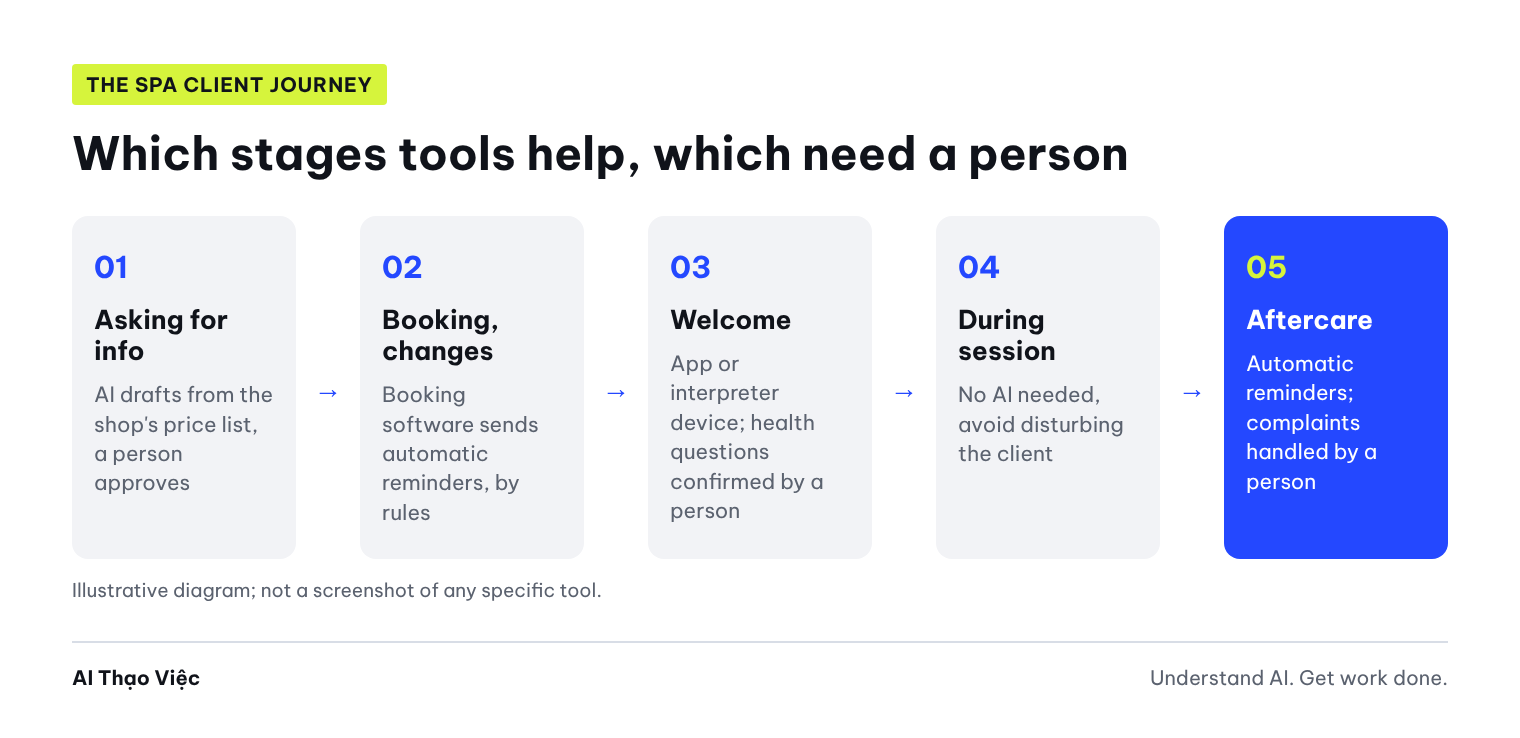
| Stage | Common tasks | Tools that can help | The part a person must keep |
|---|---|---|---|
| Asking for information | Prices, duration, opening hours, is there parking | AI drafts a set of replies from the shop's price list; a chatbot on Zalo OA (a business's official account on Zalo) or Messenger | Approve prices and promotions before use; pass health questions to a person |
| Booking, changing, canceling | Missed calls while serving a client, unanswered messages, last-minute cancellations | Booking software (automation); AI call answering (currently seen mostly abroad) | Confirm double bookings and each technician's hours |
| Welcoming, discussing needs | Foreign clients asking about pressure, areas to avoid | Translation app on a phone, interpreter device at the front desk | Pregnancy, underlying conditions, allergies, wounds, painful areas: a qualified person asks and confirms |
| During the session | Client needs quiet | Usually no AI needed | Do not place noisy or recording devices next to the bed |
| Payment | Charging for packages, treatment cards | Point-of-sale software (automation) | Reconcile cash at the end of the day |
| Aftercare | Thank you, next appointment, handling complaints | Automatic reminders; AI drafts messages by client group | Do not send health advice written by AI on its own; complaints are handled by a person |
Tasks not to leave to AI alone
- Contraindications and health. A client asks whether they can have a massage while pregnant, with high blood pressure, after recent surgery, or with a skin condition: AI does not give advice, and machine translation is not enough to confirm. A qualified person at the shop answers.
- A client reports pain or discomfort during or after a session: a person handles it right away, never a chatbot.
- Complaints, refunds, deposits: the wording can become a commitment, so a person approves it.
- Final prices and promotions: AI may quote an old price or "give" an offer that does not exist.
- Client data: do not paste a client's full name and phone number together with their health condition into a public AI tool. When testing, use booking codes or fake data instead. The article Using AI with customer data: what you can and cannot do (in Vietnamese) summarizes the rules currently in force.
Which task to try first?
Choose a task with four traits: it repeats many times a day, mistakes are easy to spot and fix, it does not touch client health, and you can count it before and after. Three candidates that suit a small shop:
- A set of sample replies for 10 common questions. Ask ChatGPT or Gemini to draft them once from your price list, have staff edit them, then save them as message templates. AI does not reply to clients directly; a person still presses send.
- Automatic appointment reminders if clients often forget their bookings. This is automation and needs no AI. How to choose software is covered in the article on calls and bookings at the end of this page.
- Interpreting with a phone app for 2 weeks if you have many foreign clients, before considering a dedicated device.
Try it now: draft a set of sample replies (simulated example)
Paste the text below into ChatGPT, Gemini or Claude. The shop name, prices and hours are all simulated; in real use, replace them with your own price list and do not include client information.
You are an assistant who drafts messages for a small massage shop. Use only the information in the TABLE BELOW; if a question needs information that is not in the table, write exactly "[Owner needs to add]" instead of guessing.

INFORMATION TABLE (simulated):
- Name: Hoa Sen Massage, 12 ABC Street, District 3
- Opening hours: 9:00 to 21:30, last client accepted at 20:00
- Body massage 60 minutes: 350,000 VND; 90 minutes: 480,000 VND
- Foot massage 45 minutes: 220,000 VND
- Herbal head spa wash 45 minutes: 180,000 VND
- Book via Zalo at 09xx xxx xxx; slots held for 15 minutes

Write short, polite replies, speaking as "Hoa Sen" and addressing the customer politely as sir/madam, for these 10 questions:
1. How much is a body massage?
2. What time do you close?
3. Can you still take a client at 20:30 tonight?
4. Do you have female therapists?
5. Is there car parking?
6. I'm 5 months pregnant, can I get a massage?
7. Is there a discount for 2 people?
8. Do you take card payments?
9. Is it okay if I'm 20 minutes late?
10. What does the 90-minute package include?

Present it as a 3-column table: Question | Reply | Information used from the table.
Expected output (Editorial answer, not run on a tool): questions 1, 2, 3 and 9 can be answered from the table (question 3: the last client is accepted at 20:00, so 20:30 is past the cutoff). Questions 4, 5, 7, 8 and 10 should say "[Owner needs to add]". Question 6 must not be answered with yes or no: the right template only invites the client to call directly so staff can ask more.
Quick check: compare every number against the price list; look for any answer where AI added information on its own (for example "10% off for groups"); read answer 6 to see whether anything sounds like health advice. Fix any wrong answer by hand before saving it as a template.
How to read the sales pitch
Vendor websites often quote figures such as fewer cancellations, higher efficiency or hours saved per week. These are the seller's own claims, usually without the measurement method, sample size or measurement period, so they cannot replace your own shop's numbers. For example, Fresha's scheduling page cites a reduction in cancellations from businesses using the service, and SpaAI's page states an "efficiency increase"; neither states the measurement method on the page. This article does not use those figures.
Three questions to ask when you hear a pitch: is this feature AI or an automatic rule? Can you try it on your shop's fake data? What does the total monthly cost include (software fee, messaging fees, setup fee)? The article Choosing an AI tool for a small business: 6 questions before you pay (in Vietnamese) has a fuller list.
Try for 2 to 4 weeks, record numbers before buying
Choose one task, record your current numbers for 2 to 4 weeks (missed calls, cancellations, staff minutes spent), then run the trial for a similar period. Only expand when the benefit left after subtracting every cost is still worth it. How to record and the formulas are in this series' article on measuring results.
Articles in this series
- Interpreting for spa clients: a phone app or a dedicated device?
- Small spas handling calls and open slots: do it yourself, booking software or AI call answering?
- Measuring AI at a spa: do the time saved and the bookings kept cover the cost?
- The same type of article for another industry: What can small restaurants and shops use AI for? (in Vietnamese)
Limits of this article
- We have not interviewed spa owners or tested the tools at a business in Vietnam; product information comes from vendor websites.
- Product names are examples, not purchase recommendations. Prices and features may change after the check date.
Sources & notes
- Fresha: Scheduling (vendor feature page)
- SpaAI: introduction page (vendor page)
- Addy: solutions for spas and aesthetics (vendor page)
- DayAI (vendor page, serving Australia and New Zealand)
- Google Translate Help: Translate a bilingual conversation
- Checked on 29 Sep 2026. Descriptions and figures on vendor pages are the seller's own claims and have not been independently verified.