Is reminder software or a chatbot that answers guests worth the money for your spa? No advertising page can answer that for you. This article shows how to measure one small task yourself over a few weeks: record the numbers first, run the trial, then calculate the benefit left after subtracting every cost.
The article does not promise any level of savings in advance. The goal is to have enough numbers to decide whether to expand, keep things as they are or stop, and not to fool yourself with one week that happened to be busy.
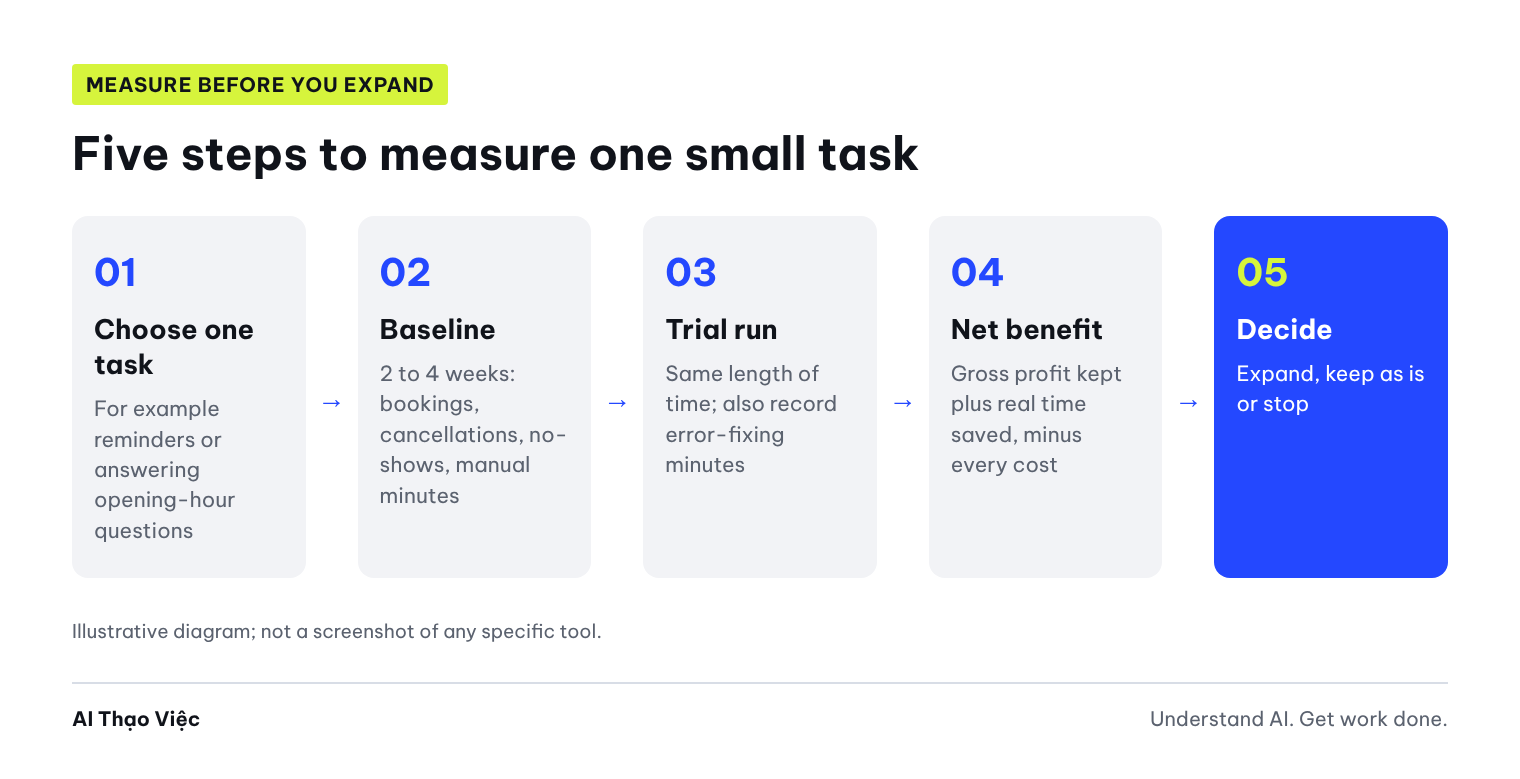
Step 1: choose exactly one task
Measure a task you can count, for example:
- Reminders before appointments (automation).
- Answering questions about opening hours, prices and address on Zalo (a chatbot or AI drafting replies).
- Telling waitlisted guests when someone cancels.
Do not measure "the whole system" at once: when many things change together, you cannot tell what made the difference.
Step 2: record baseline numbers for 2 to 4 weeks
Before switching the tool on, record numbers in a spreadsheet every day. Use a booking code instead of the guest's name; do not put phone numbers or health conditions in the measurement table.
| Metric | How to record | Why you need it |
|---|---|---|
| Bookings made | Count at the end of the day | Denominator for the rates |
| No-shows (no notice) | Count by day | This is what reminders target |
| Last-minute cancellations (under 3 hours) | Count by day | Slots that are hard to fill |
| Cancelled slots refilled | Count when a replacement guest comes | This is what the waitlist targets |
| Staff minutes spent by hand | Estimate weekly: reminder calls, replying to messages | Time that could be saved |
| Missed calls and messages | Count from the phone and Zalo logs | Guests you may lose |
| Unusual events | Holidays, promotions, staff shortages, heavy rain | So you do not mistake the cause |
Step 3: run the trial over the same length of time
Switch the tool on and keep recording exactly the metrics above, plus three new rows:
- Minutes fixing errors: time staff spend checking and fixing the tool's output (reminders with the wrong time, a chatbot giving the wrong price).
- Number of handovers to a person and number of wrong AI answers, if there is AI.
- Guest feedback: praise or complaints about the messages or the replies.
Try to keep the same opening hours and the same number of therapists, and compare with equivalent weeks (do not compare a week during Tết, the Lunar New Year, with a normal week).
Step 4: calculate the net benefit
Formula:
Net benefit = (extra bookings kept × gross profit per booking)
            + (staff hours actually saved × cost per hour)
            minus (software fee + message fees + setup and training)
Two common miscalculations:
- Gross profit, not revenue. A 350,000 VND booking does not bring in 350,000 VND; subtract the therapist's commission, oils, towels, and per-session electricity and water, and what is left is the gross profit.
- Only count saved hours if they are used for other useful work. If the spa is quiet and staff sit waiting, the "saved" hours do not turn into money.
Worked example (simulated data)
A spa tries automatic reminders for 4 weeks and compares with the previous 4 weeks:
| Metric | Previous 4 weeks | 4 trial weeks |
|---|---|---|
| Bookings made | 320 | 316 |
| No-shows | 24 | 15 |
| Cancelled slots refilled | 4 | 7 |
| Minutes of manual reminder calls | 600 | 160 |
| Minutes fixing system errors | 0 | 60 |
Assumptions (simulated): gross profit per booking 180,000 VND; staff cost 40,000 VND/hour; software fee 400,000 VND/month; message fee 500 VND/message for 316 messages; setup and training 4 hours.
- Extra bookings kept: (24 minus 15) + (7 minus 4) = 12 bookings, so 12 × 180,000 = 2,160,000 VND.
- Time: 600 minus 160 minus 60 = 380 minutes, about 6.3 hours, so about 253,000 VND.
- Costs: 400,000 + 158,000 (messages) + 160,000 (setup) = 718,000 VND.
- Estimated net benefit: 2,160,000 + 253,000 minus 718,000 = about 1,695,000 VND over 4 weeks.
Do not stop at that number. Four weeks is a small sample; no-shows naturally go up and down each month. Try assuming only half the extra bookings kept are thanks to the tool: 6 × 180,000 + 253,000 minus 718,000 = about 615,000 VND. Still positive, but much thinner.
A simpler way to look at it is the break-even point: how many extra bookings do you need to keep to cover the cost?
Break-even bookings = (total cost minus value of time saved) / gross profit per booking
                    = (718,000 minus 253,000) / 180,000 ≈ 2.6 bookings over 4 weeks
So this simulated spa only needs to keep about 3 extra bookings over 4 weeks to break even. If the tool costs more or the gross profit per booking is lower, redo the calculation with your own numbers.
Step 5: decide
| Result | What to do |
|---|---|
| Net benefit positive even counting only half the improvement, no extra complaints | Keep it, consider expanding to a second task |
| Net benefit around 0, or positive only when counting the full improvement | Try another 4 weeks, or look for a cheaper plan |
| Net benefit negative, or guests complain, or error-fixing minutes keep rising | Stop; go back to tidy manual work |
For tools where AI answers guests, add one more condition: if the AI has ever answered a health question or complaint itself instead of handing over to a person, fix the settings before expanding, even if the numbers look good.
Ask AI to build the spreadsheet (without guest data)
Paste the text below into ChatGPT, Gemini or Claude to get a spreadsheet structure; describe the columns only, do not paste real guest data.
Create a Google Sheets spreadsheet structure for a small spa to measure the effect of a booking reminder tool over 8 weeks (4 baseline weeks, 4 trial weeks).
Sheet 1 "Daily log": columns Date, Phase (Baseline/Trial), Bookings made, No-shows, Last-minute cancellations, Cancelled slots refilled, Manual minutes, Error-fixing minutes, Missed calls, Unusual events.
Sheet 2 "Summary": totals of each metric by phase; input cells for Gross profit per booking, Cost per hour, Software fee, Message fee, Setup cost; formulas for Net benefit, Net benefit counting only 50% of the improvement, Break-even bookings.
Write the formula for each summary cell and briefly explain each formula. No columns for guest names or phone numbers are needed.
Check the output: enter the numbers from the simulated example above; the sheet must give exactly 1,695,000, 615,000 and 2.6 (rounded). If it does not match, review the formulas before using it.
Things that easily skew the results
- Seasons and occasions: holidays, Tết, the start of the month after payday, the rainy season.
- Promotions running at the same time as the trial.
- Staff changes: a new receptionist, a therapist leaving.
- Changed opening hours or changed prices.
- Forgetting to count error-fixing minutes, which makes the tool look better than it really is.
Record these factors in the notes column. When several factors happen at once, the conclusion is "not enough data", not "the tool works".
FAQ
The vendor's page says cancellations drop a lot, so why measure myself?
That figure usually comes from their own customer base, does not say how it was measured, and is not your spa. It can be a reason to try, not a reason to buy long term.
Is measuring for 1 week enough?
For reminders and no-shows it is usually not enough, because weekly numbers are small and go up and down. Aim for at least 2 to 4 weeks per phase. For measuring the time spent writing messages, the article Does AI really save time? How to measure it yourself in 1 week (in Vietnamese) has its own measurement table.
What if I do not know my gross profit per booking?
Take your most popular service price and subtract the therapist's commission and supplies per session. Estimating a little low is better than using the full selling price.
Related articles
- AI in spas and massage shops: what to try first, and what needs a human check?
- Interpreting for spa guests: phone app or dedicated device?
- Small spas handling calls and open slots: do it yourself, booking software or AI call answering?
- For businesses in general: Trying AI in a business: what to measure to know whether to continue? (in Vietnamese)
Limits of this article
- Every number in the example is simulated to illustrate the calculation, not the results of a real spa.
- Measuring before and after over a few weeks does not prove for certain that the tool is the cause; it helps you decide with less risk.
Sources & notes
- This article is a self-measurement method and does not rely on any vendor's data.
- The advertised figure mentioned in the FAQ: for example Fresha: Scheduling, a page that cites a reduction in cancellations but does not say how it was measured (checked on 29 Sep 2026).