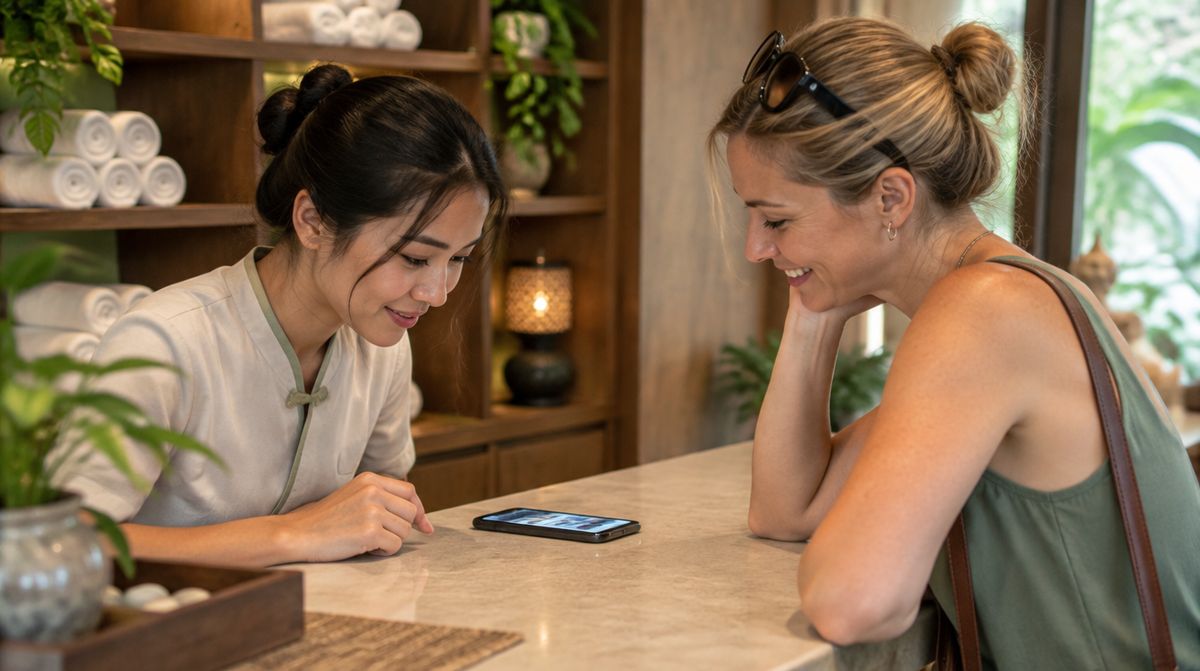
Foreign guests at a spa usually ask the same few questions: how much does it cost, how long does it take, light or firm pressure, which areas to avoid. There are three ways for both sides to understand each other: a translation app on a phone, a two-screen interpreter device at the front desk, or a person who speaks the language. This article helps you choose by guest volume, languages, space, privacy level and money. It does not rank products.
AI interpreter devices recognize speech, turn it into text, translate it, then read it aloud or show the text to the other person. This works fast with short, clear sentences. It easily gets amounts of money, times, negative sentences ("do not") and health questions wrong. So the right question is not "which device translates best" but "which conversations at my spa need which tool".
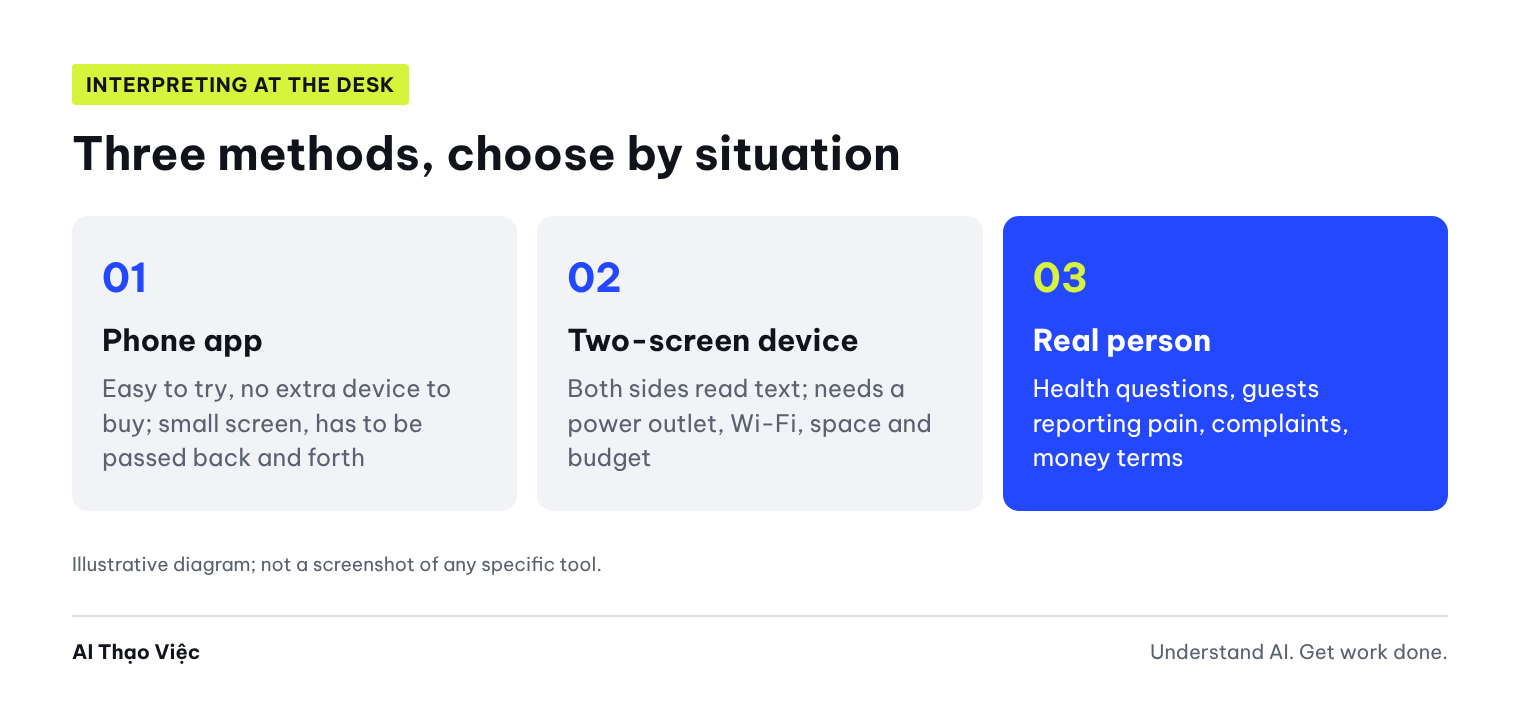
Three methods: how they differ
| Phone app | Two-screen desk device | Real person | |
|---|---|---|---|
| Examples | Google Translate, Samsung Galaxy AI Interpreter | Off-the-shelf two-screen interpreter devices, many sellers | Staff who speak the language, interpreters paid by the hour |
| Upfront cost | Free app, uses a phone you already have | One-time device purchase, price varies by seller; also ask about software fees in later years | Salary, allowance or hourly fee |
| How it works | Face to face mode: placed between two people, each reads half the screen; small screen | Each side looks at one screen; stays in a fixed place | Normal conversation |
| What it needs | Internet; a loud enough speaker | Power outlet, Wi-Fi, space on the desk | Someone present at the right time |
| Best for | Spas with few foreign guests, short questions | Desks with many foreign guests, many languages, where both sides need to read text | Health questions, guests reporting pain, complaints, money terms |
| Unclear, need to ask | Whether offline translation supports Vietnamese | Language list, whether audio is stored, independent reviews | Cost and when someone is available |
Phone app: the easiest to try
If you do not have the app yet, download Google Translate from the official store: Google Play (Android) or App Store (iPhone). The app is free; these are not affiliate links.
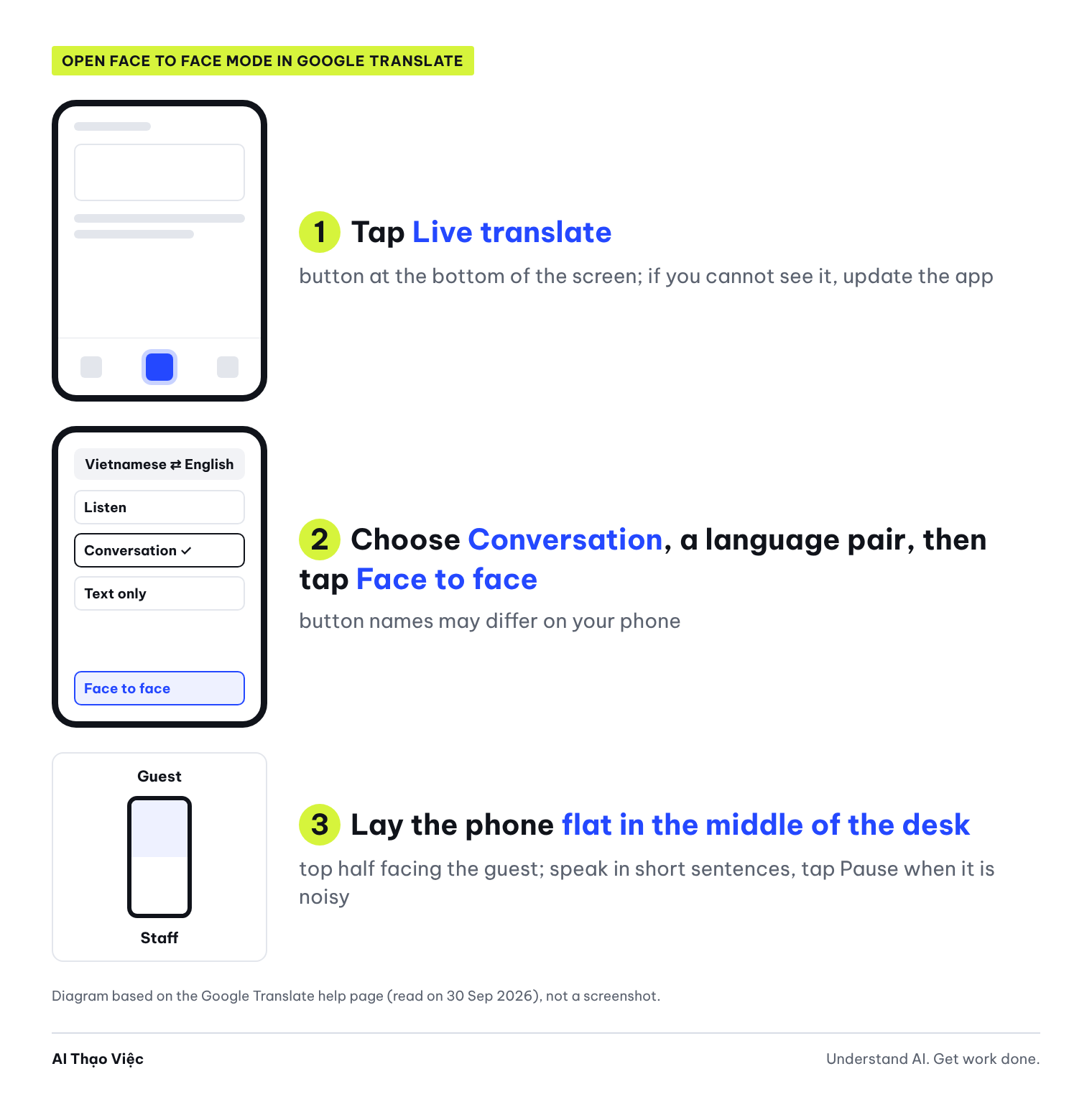
According to Google's help page, in the Google Translate app on Android and iPhone you tap Live translate at the bottom of the screen, choose Conversation mode, pick two languages, then tap to speak. The microphone detects when one person finishes and the other starts speaking in the other language; the translation is read out through the phone speaker or headphones. Google describes this as "near real-time" translation.
Vietnamese is in the language list for live translate, according to the help page.
Face to face mode: one phone instead of a two-screen device
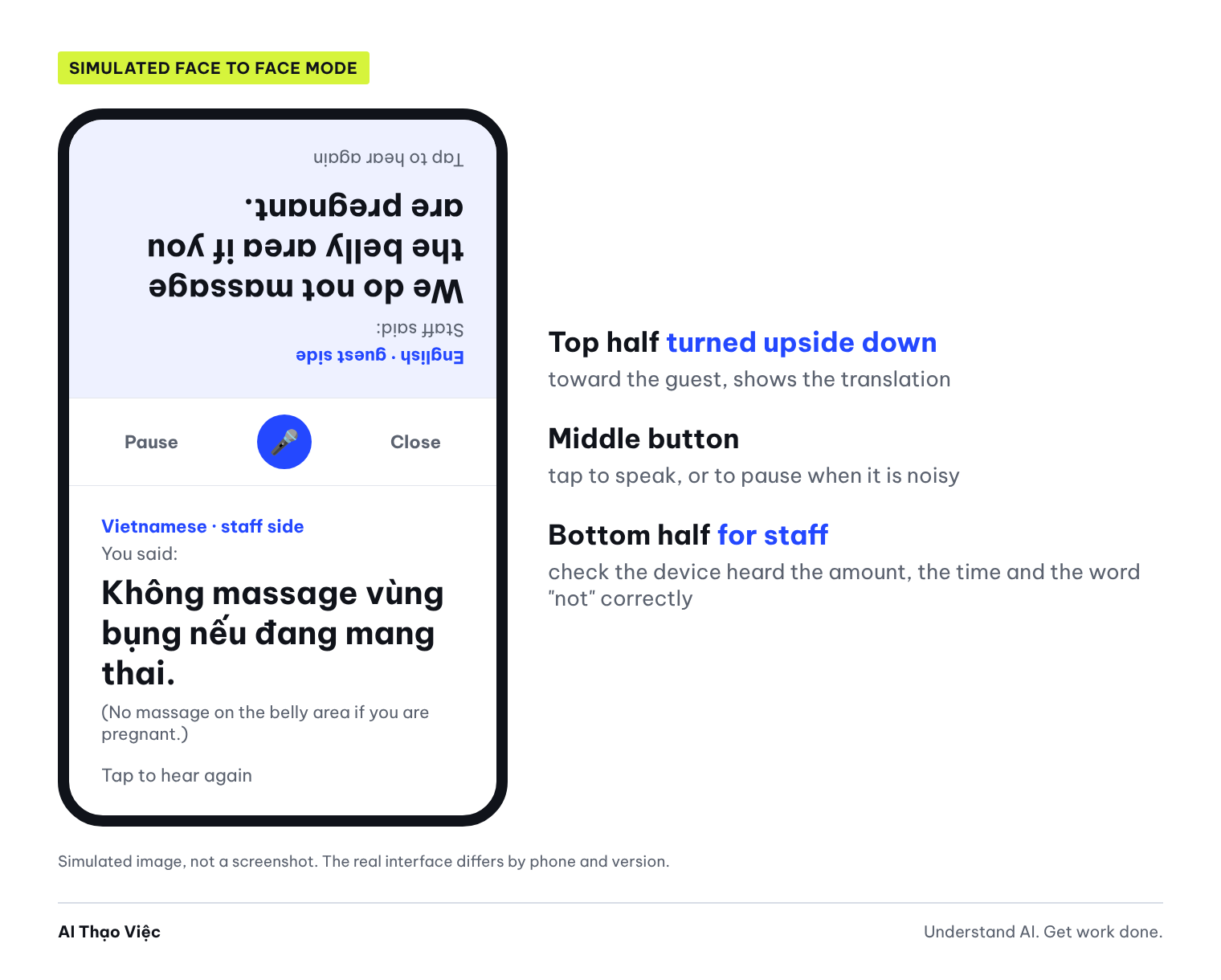
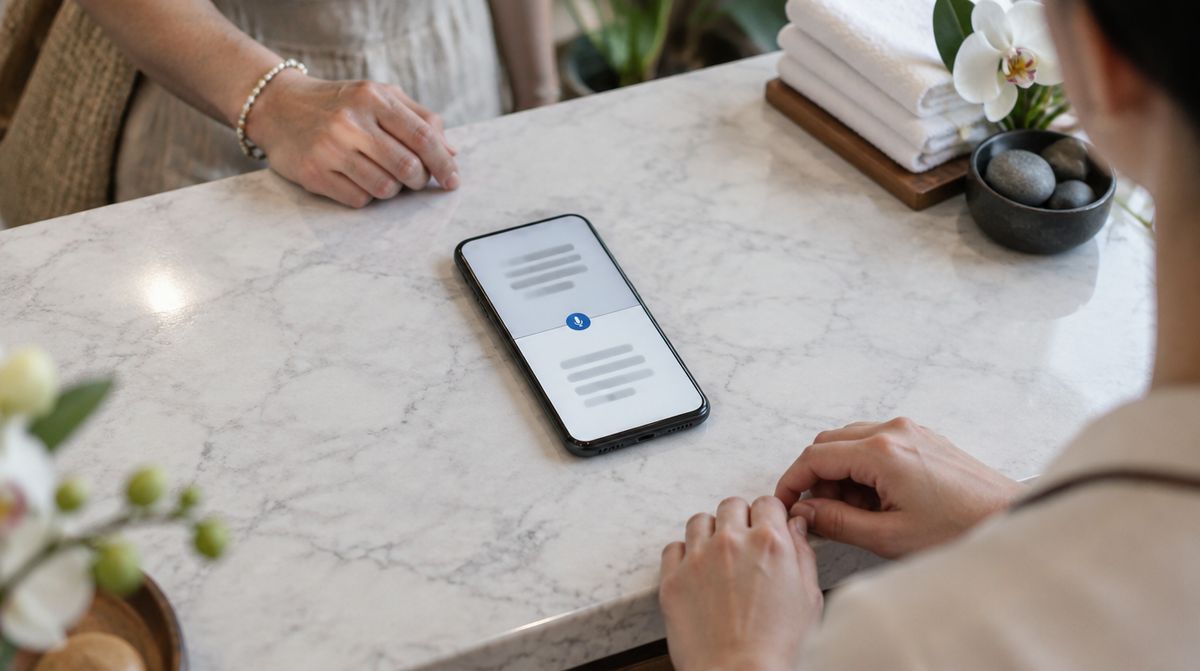
The help page for both Android and iPhone (rechecked on 30 Sep 2026) describes Face to face mode: the screen splits in two, and each person reads what they said and the translation on their own half. Tap Speak to pause or resume, tap Close to exit. Lay the phone flat in the middle of the desk with the top half turned toward the guest, and you get close to how a two-screen device works without buying anything.
If your spa uses Samsung Galaxy phones: the Galaxy AI Interpreter app also has a two-screen mode for face-to-face conversations. Samsung's support page lists the Galaxy Z Fold6, Z Flip6 and the S24, S25 and S26 series, and advises keeping a stable internet connection. Samsung added Vietnamese to its live translation feature at its early 2024 launch (according to VietNamNet). Open it and try it before relying on it, to see whether your phone actually has this feature.
Good to know: the help page says offline translation in this mode is currently only available on some Pixel phones and for some language pairs with English; that list of pairs did not include Vietnamese on the date we checked. So at the desk, assume you need internet. The interface may differ by version; if you cannot find the button, update the app first.
Two-screen device: handy at a busy desk, but ask carefully before buying
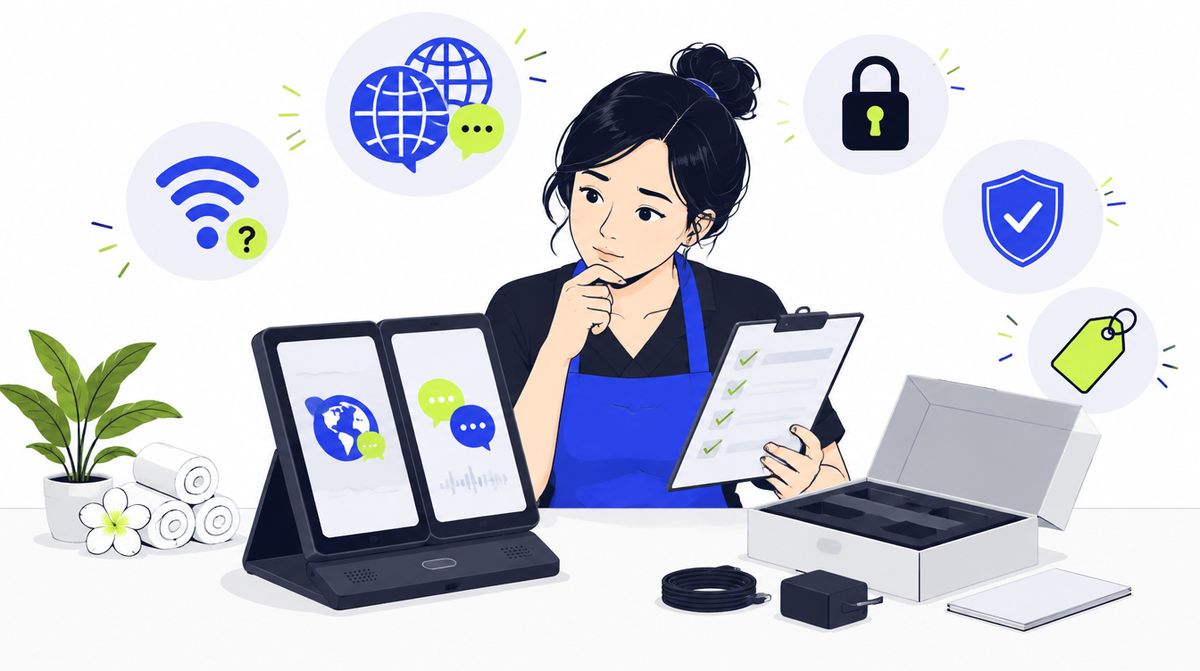
Many sellers offer this kind of device, with different prices and specs, and this article does not rank or recommend any brand. When you read a product page, check all of these: language list, whether there is a Vietnamese voice, whether audio is stored, what still works without internet, what the warranty covers, and whether there are buyer reviews. Ask about anything the page does not state before you buy (the list of questions is at the end of the article).
The obvious advantage of this type of device is that both sides read text on their own screen, so staff can see whether the device heard correctly before answering. The downsides are that it takes up space, needs power and stable Wi-Fi, and is a large expense for a small spa if only a few guests a day need interpreting. Before buying, try Face to face mode on a phone you already have for a few weeks: if it is good enough, you do not need a separate device yet.
Real person: irreplaceable in some situations
In these moments you should have someone who understands the guest's language, or use a bilingual form reviewed by a qualified person:
- Questions about pregnancy, underlying conditions, allergies, wounds, recent surgery, current medication.
- The guest reports pain or discomfort during the session.
- Complaints, refunds, deposits, cancellation policy.
- The guest cannot read the text on the screen or has hearing difficulties.
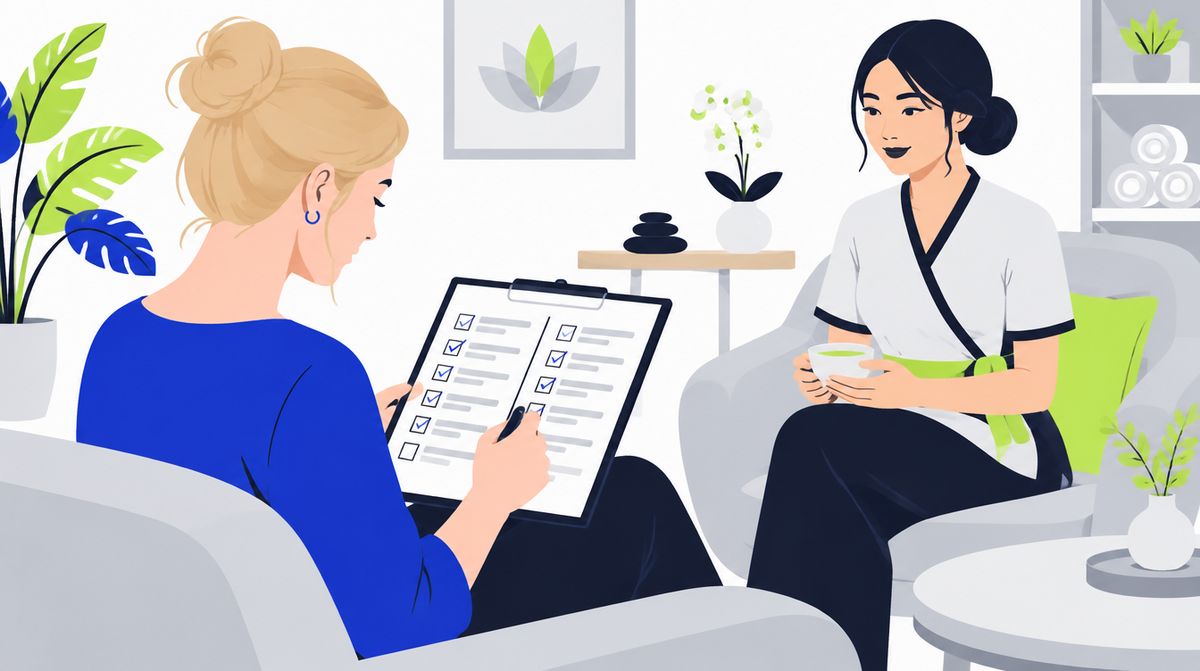
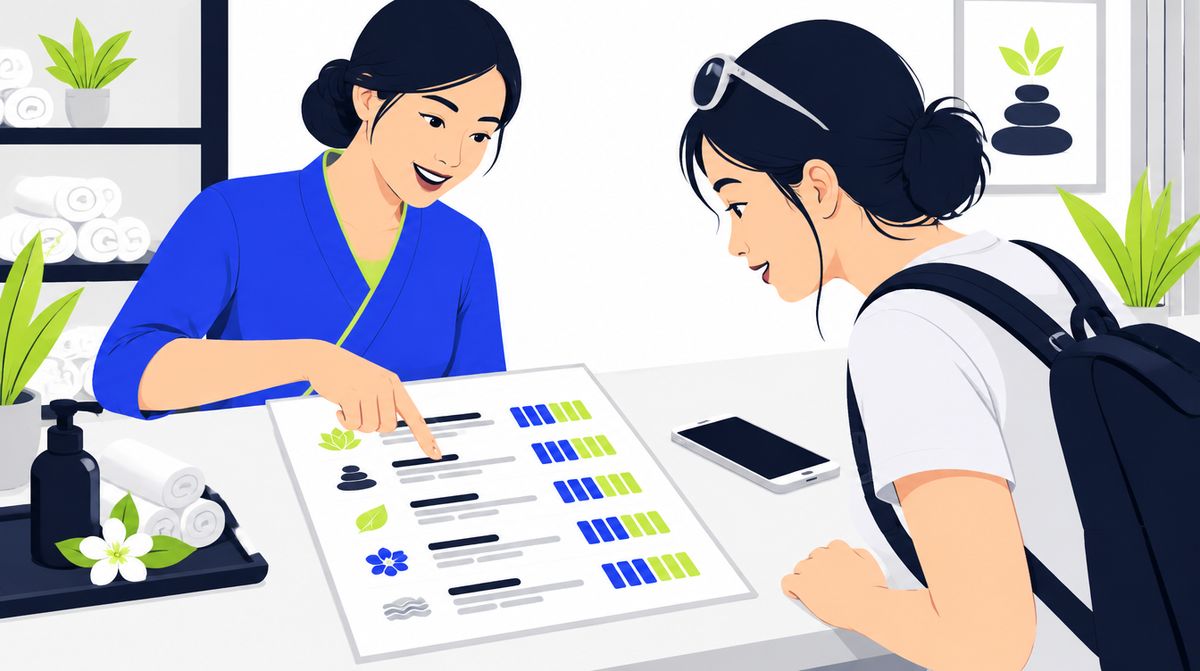
Practical tip: print a bilingual health questionnaire in the languages your guests use most, and have someone who speaks the language review the translation once. Guests tick boxes on paper instead of answering through a translation device.
Do not speak health information together with a guest's name into a translation app if you do not know how the app stores data.
Self-check: which method does your spa need?
| Question | Leans toward a phone app | Leans toward a desk device |
|---|---|---|
| How many guests need interpreting each day? | A few | Many, steadily all day |
| How many languages do guests speak? | One or two familiar languages | Many languages, hard to predict |
| Where will you use it? | Many places, including while walking guests to the room | Only at the reception desk |
| Is the desk noisy? | Quiet, you can speak close to the phone | Needs a device that stays put, with both sides reading text |
| Budget | Not ready to spend more | Already tried an app for 2 weeks and found it not enough |
Whatever you choose, health questions and complaints still go through a real person or a bilingual form.
Test for 30 minutes at the desk before deciding
Step 1. Choose the two languages your guests use most. Open Google Translate in Conversation or Face to face mode (or the device you are trying, if the seller lends you one).
Step 2. Read the 8 sample sentences below (simulated; replace prices and times with your spa's). Ask a second person to play the guest, and play background music as at busy hours.
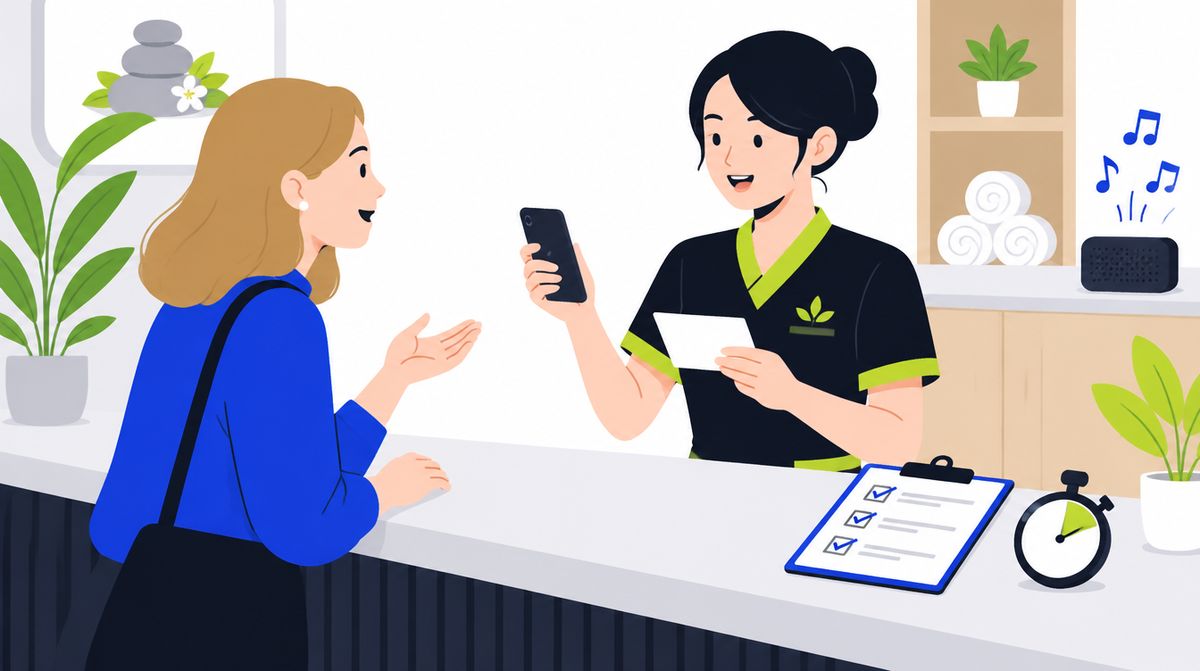
1. A 60-minute body massage costs 350,000 VND, 90 minutes costs 480,000 VND.
2. We currently have openings at 3:30 pm and 5 pm.
3. Would you like light, medium or firm pressure?
4. Is there any area that hurts or that we should avoid?
5. No massage on the belly area if you are pregnant.
6. Please arrive 10 minutes before your appointment.
7. We hold your booking for up to 15 minutes; after that we will take other guests.
8. Payment by cash or bank transfer.
Step 3. For each sentence, translate it into the guest's language, then translate it back into Vietnamese. Compare three things: the amount of money, the time, and the word "not" ("không").
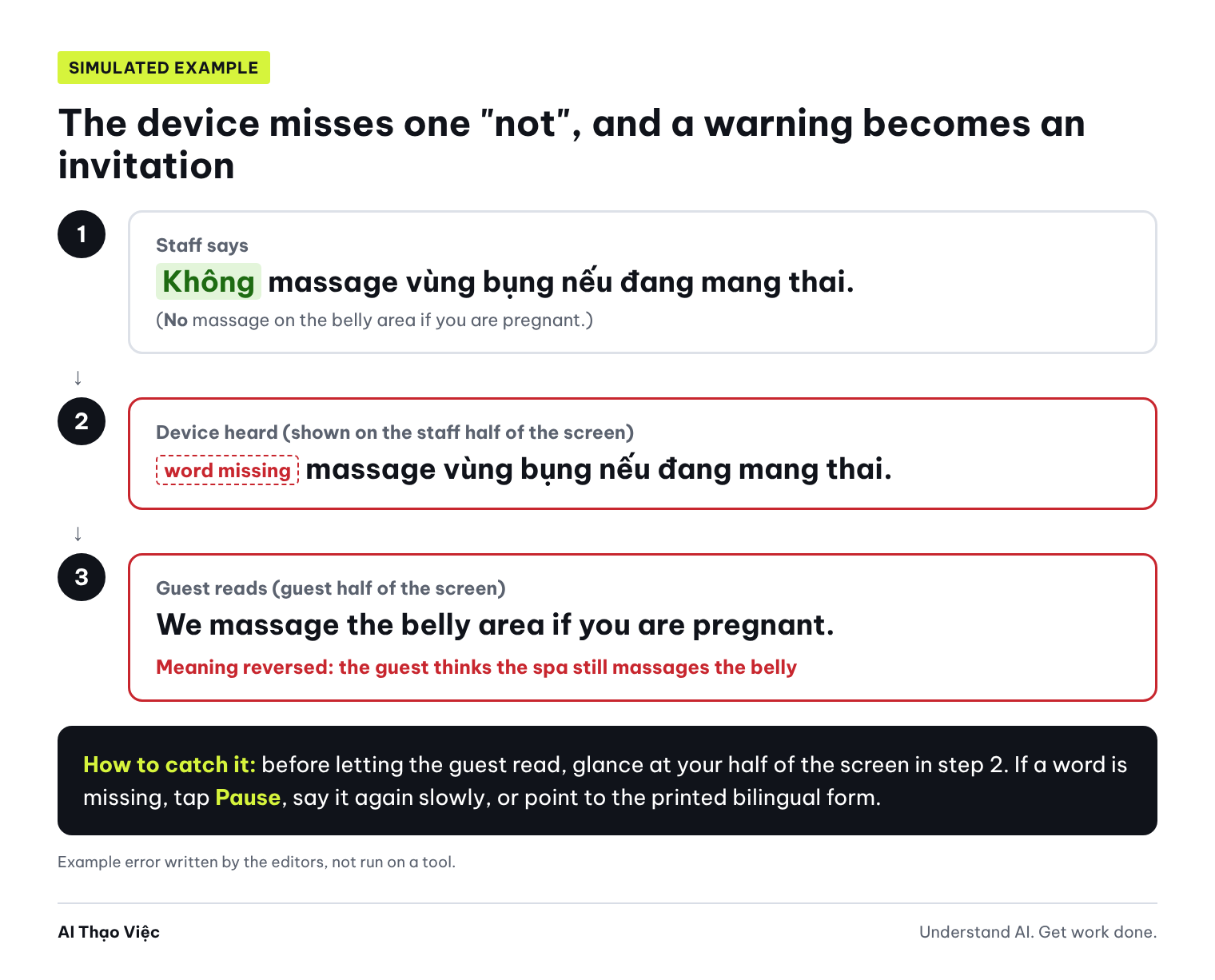
Step 4: spot a wrong translation. Example errors (simulated, written by the editors for illustration, not run on a tool):
| Original sentence | Translated back | Problem | Quick check |
|---|---|---|---|
| No massage on the belly area if you are pregnant. | Massage on the belly area if you are pregnant. | The word "no" was lost: the meaning is reversed | Always back-translate sentences containing "no" or "not" to check |
| 90 minutes costs 480,000 VND | 19 minutes costs 480 VND | Number misheard, thousands lost | Prices and times: point to a printed price list instead of reading aloud |
| We hold your booking for up to 15 minutes | We hold your booking for 50 minutes | "Fifteen" and "fifty" ("mười lăm" and "năm mươi") are easily confused in noise | Say numbers slowly, or type numbers instead of speaking |
Step 5. Record the results: which sentences were right in both directions, which were wrong, and whether errors came from noise or from difficult sentences. If a health sentence is wrong, that sentence needs a bilingual form; it is not a reason to buy a more expensive device.
Step 6. Only call it "tested" when you have recorded all of these: date, which phone or device, which languages, which situations, and the results.
Questions to ask interpreter device sellers
- Which languages are supported, is there a Vietnamese voice, and is the list stated in the documentation?
- Does the device need internet; what can it still translate if Wi-Fi drops?
- Are audio and text stored, where, for how long, and can they be deleted?
- Are there software or service fees after the first year?
- Can you borrow it, or return or exchange it if it does not suit your spa after testing?
- What does the warranty cover, for how long, and where are repairs done?
FAQ
Do interpreter devices translate more accurately than phone apps?
This article has no independent comparison data for these two types when used in a spa. The surest way is to have both read the same 8 sample sentences above, in the same noise, and count the errors.
Should you keep a translation device next to the massage bed?
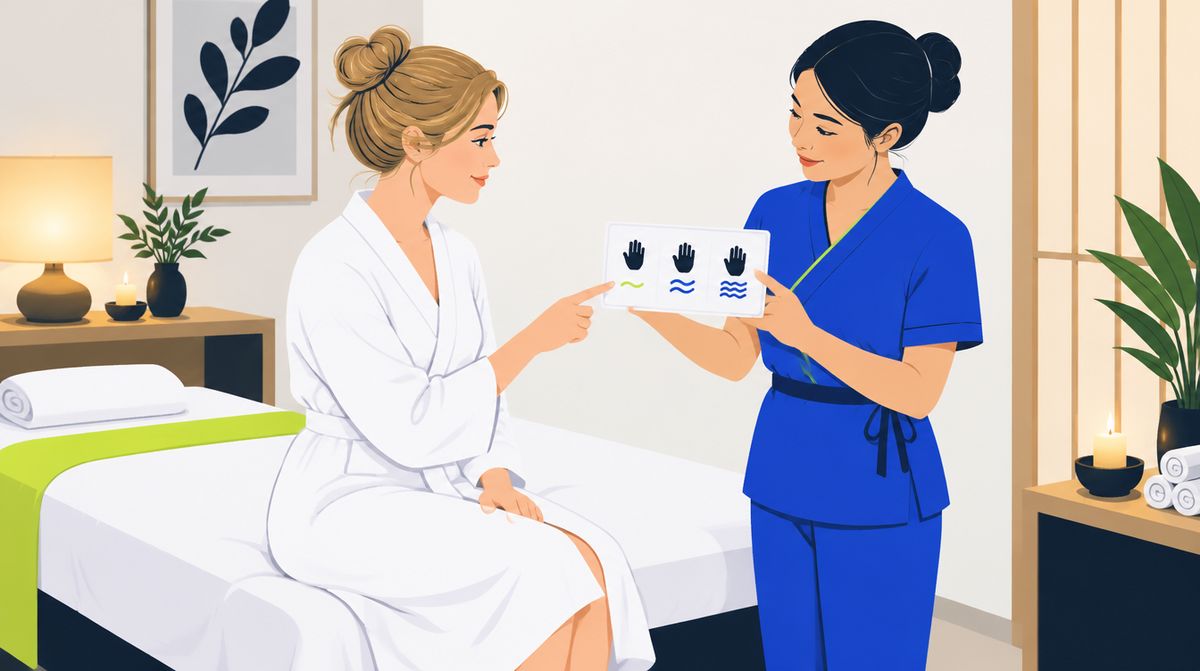
Usually not. Guests need quiet and privacy; if you need to ask something during the session, use a few short printed bilingual phrases or ask a person to help.
Who is responsible for a wrong translation?
The spa is responsible to the guest. That is why sentences that can cause harm if misunderstood (health, money, commitments) should not rely on a device alone.
Related articles
- AI in spas and massage shops: what to try first, and what needs a human check?
- Small spas handling calls and open slots: do it yourself, booking software or AI call answering?
- Measuring AI at a spa: do time saved and bookings kept cover the cost?
- Translating text instead of speech: Translating Vietnamese emails into English with AI: keeping names, amounts and terms intact (in Vietnamese)
Limits of this article
- We have not tested Google Translate, Samsung Interpreter or a two-screen device at a spa; the error examples are simulated to illustrate how to check.
- Interface images are simulations based on the help pages, not screenshots; the spa scene images were created with AI for illustration.
- The article does not name or price any specific two-screen interpreter device; ask sellers directly for quotes and specs.
- The article does not assess the accuracy of any product.
Sources & notes
- Google Translate Help: Translate a bilingual conversation (Android and iPhone versions)
- Google Translate Help: Tips & Tricks
- Samsung: How to use listening mode and dual screen mode in the Interpreter app
- VietNamNet: Vietnamese supported in Samsung's new AI live translation feature (in Vietnamese, 19 Jan 2024)
- Rechecked on 30 Sep 2026.