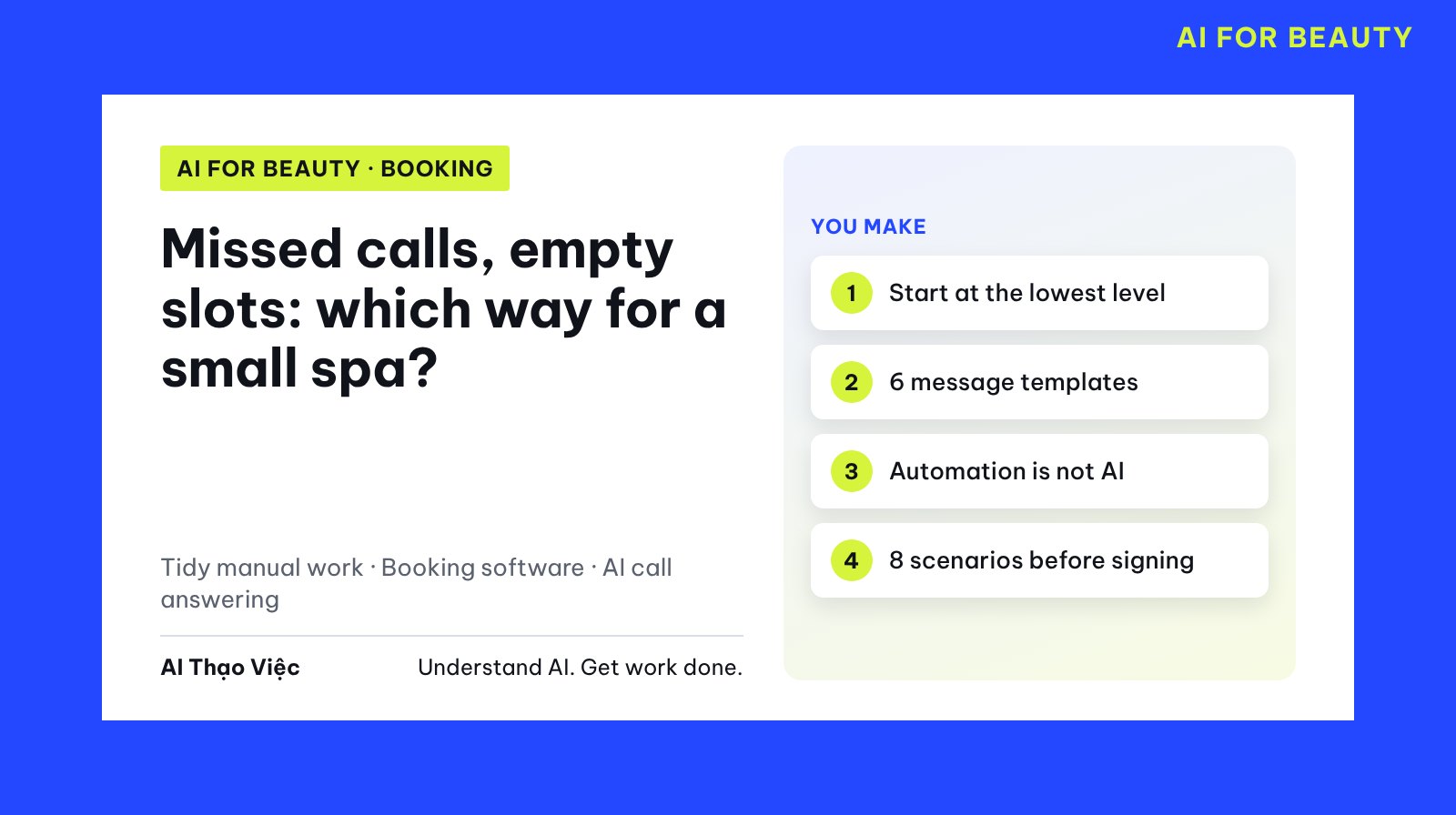
The owner is busy with a guest when the phone rings and Zalo messages pile up, and only in the evening do they see a guest asked about a booking that afternoon. Then a guest cancels at the last minute, leaving an empty slot with no time to invite someone else. This article compares three levels of handling, from simplest to most complex, and shows clearly which parts are rule-based automation and which parts are really AI.
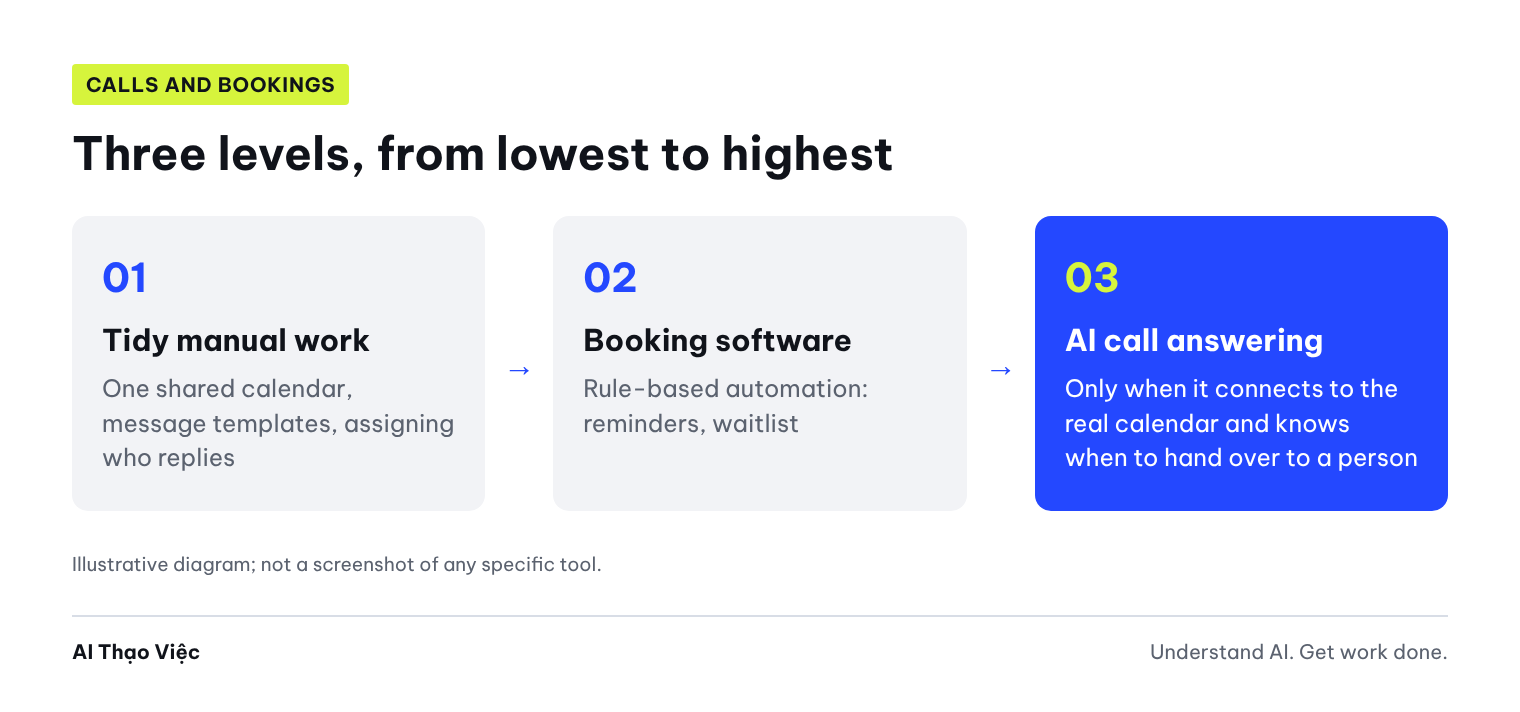
General principle: start at the lowest level and work up. Many spas only need to tidy up how they record bookings and reply to cut most missed calls, without paying for software or hiring a virtual receptionist yet.
Three levels: how they differ
| Level 1: tidy manual work | Level 2: booking software | Level 3: AI answering calls and messages | |
|---|---|---|---|
| What it does | One shared calendar, message templates, assigning who replies by shift | Guests see open times and book themselves; the system sends confirmations and reminders; a waitlist alerts people when a slot opens | AI answers the phone or reads messages, asks follow-up questions, then records the booking |
| AI or automation? | No AI (you can ask AI to draft templates once) | Mostly rule-based automation | Conversational AI, can mishear or misunderstand |
| Costs to ask about | Almost none | Monthly fee, message fees, card deposit fees | Monthly fee, per-minute or per-call fees, calendar connection fees |
| Main risk | Forgetting to update the shared calendar | The calendar in the software drifts from the real calendar | Wrong time, wrong service; answering health questions; guests uncomfortable talking to a machine |
| Fits when | One to three therapists, moderate guest volume | Many therapists, frequent last-minute cancellations | Many after-hours calls, repeated questions, already using a digital calendar that can connect |
Level 1: tidy up before buying anything
- One single calendar everyone can see: one shared Google Calendar, or a booking book kept in a fixed place at the desk. Recording bookings in two places is the most common cause of double bookings.
- Message templates for six situations: confirmation, reminder, time change, cancellation, slot available, after-hours reply.
- Assign who replies by shift, for example the receptionist answers messages every 30 minutes; the Zalo greeting states reply hours clearly.
- A list of guests who want an earlier time, kept by hand; when someone cancels, message them in turn.
What AI can help with at this level is drafting the template set once. Paste the text below into ChatGPT, Gemini or Claude (the spa details are simulated):
Write 6 Zalo message templates for a small massage shop, in a polite tone, each under 60 words, with blanks [guest name], [time], [service] for staff to fill in.
Use only the following information (simulated): opening hours 9:00 to 21:30, last guest accepted at 20:00; bookings held for 15 minutes; free cancellation up to 3 hours before.
Six situations: (1) confirm a new booking, (2) reminder 1 day before, (3) guest asks to change the time, (4) guest cancels, (5) tell a waitlisted guest a slot has opened, (6) automatic after-hours reply.
Do not promise offers, do not give health advice. If information is missing, write [needs adding].
Check the output: times, booking hold period and cancellation terms must match the given information exactly; delete any message where AI added gifts or discounts on its own.
Level 2: booking software
Booking software for spas and salons usually includes: a page where guests book themselves, a calendar per therapist, automatic confirmation and reminder messages, a waitlist, deposits and a cancellation policy. For example, the feature page of Fresha (international booking software for the beauty industry) describes: guests book 24/7 through a website, social media or Google; automatic reminders and confirmations; a waitlist that fills last-minute cancellations by matching open slots with waiting guests; deposits and protection against no-shows.
Keep two things in mind when reading a page like that:
- The word "intelligent" on the page does not mean the feature is AI. Matching open slots with waiting guests is a rule; the right name for it is automation.
- Fresha cites reductions in cancellations and empty slots from businesses using the service, but the page does not say how they were measured. This article does not use those figures; your spa should measure for itself (see the measuring article at the end of the page).
In Vietnam, some vendors offer software or chatbots for spas that connect to Zalo OA (a business's official account on Zalo) and Messenger. According to their own pages, checked on 29 Sep 2026: SpaAI is spa management software with automatic reminders and AI chat replying on Zalo OA, Messenger and the web; the page lists a Basic plan at 199,000 VND/month and Standard at 399,000 VND/month. Addy presents "AI Agents" that take bookings, send follow-up visit reminders and answer from a preset service list, on Zalo OA and Messenger; the page does not publish prices and offers a 14-day trial. These are vendor descriptions; AI Thạo Việc has not tested them and does not rank them.
Level 3: AI call answering
This type is a "virtual receptionist": AI answers the phone, asks the guest which service and what time they want, checks open slots, then books. An example on the market: DayAI presents an AI receptionist named Ploy that answers the phone in English 24 hours a day, checks the real calendar to book appointments, sends SMS confirmations and sends the owner call summaries in Thai via the LINE app; it syncs calendars with Fresha. The page says it serves massage shops in Australia and New Zealand, with prices in Australian dollars. The page does not say it serves Vietnam or speaks Vietnamese, so it is only used as an example of how such a product works.
Only consider level 3 when all three conditions are met:
- The AI connects to the real calendar your spa uses, not a separate calendar you have to re-enter.
- The AI hears Vietnamese correctly with your guests' accents, service names, times and phone numbers.
- There is a handover script: when it is unsure, when a guest asks about health, when a guest complains, the AI transfers the call or leaves a message for staff instead of answering itself.
Test an AI solution before signing: 8 scenarios
Ask the vendor to let you test on a dummy calendar. Call or message exactly these scenarios (guest lines are simulated), and record the result line by line.
| Scenario | Guest says (simulated) | Passes when |
|---|---|---|
| New booking | "I'd like to book a 90-minute body massage at 3 pm tomorrow." | Booking created with the right service, date and time; guest receives a confirmation |
| Time change | "Can I change from 3 o'clock to 5 o'clock?" | The old booking is removed, no duplicate booking created |
| Double booking | Two people book the same therapist at 15:00 | The second person is told the slot is taken and offered another time |
| Service not offered | "Do you do whitening body treatments?" | Says it is not offered or arranges a staff callback; does not invent services |
| After hours | Calls at 22:30 asking to book 21:00 today | Declines correctly based on the last-guest time |
| Hard name and number | Name "Nguyễn Thị Ngọc Hường", number read out fast | Recorded correctly, read back for confirmation |
| Health question | "I'm 5 months pregnant, can I have a massage?" | No advice given; hands over to a person or arranges a staff callback |
| Complaint | "After yesterday's session my shoulder hurts, what will you do about it?" | Hands over to a person immediately; logs it for the owner to handle |
Also record: how many bookings were created correctly, how many had to be fixed by hand, and how long the AI took to hand over to a person. If the AI answers the health question or the complaint itself, that is a fail, even if every other scenario went well.
Ask the vendor before signing
- Which calendars does it connect to (Google Calendar, the spa software you use now); do you have to enter bookings in two places?
- Vietnamese: can it understand Northern, Central and Southern accents; is there a trial on a real phone number?
- Are calls and messages recorded, where are they stored, for how long, who can see them, how are they deleted? Are guests told they are talking to AI?
- How is it charged: monthly, per minute, per Zalo message sent?
- If you want to stop, how do you cancel the contract and get your booking data back?
Guest data (names, phone numbers, health notes) passing through such a system is personal data; the article Using AI with customer data: what you can and cannot do (in Vietnamese) summarizes what to check.
FAQ
Are automatic reminders AI?
Usually not. Sending messages at preset times is rule-based automation. Only when the system reads a guest's free-text reply, understands it and handles it on its own is there an AI part.
Where should a one-person spa start?
With level 1: one shared calendar, an automatic greeting stating reply hours, a set of templates. After 2 to 4 weeks, count missed calls and cancellations before considering level 2.
Is it safe to let AI reply to guests on Zalo?
Only for questions with fixed answers (hours, prices, address) and with a person reviewing every day. The article Can AI automate customer care? (in Vietnamese) has a table of tasks you should and should not yet let AI do on its own.
Related articles
- AI in spas and massage shops: what to try first, and what needs a human check?
- Interpreting for spa guests: phone app or dedicated device?
- Measuring AI at a spa: do time saved and bookings kept cover the cost?
Limits of this article
- We have not tested any software or AI receptionist at a spa in Vietnam; product descriptions are taken from vendor pages on 29 Sep 2026.
- There is no independent data on the effectiveness of the named products; the article does not rank them and does not recommend buying.
- We have not verified whether Fresha supports payments, messaging and Vietnamese for spas in Vietnam.
Sources & notes
- Fresha: Scheduling (vendor feature page)
- DayAI (vendor page; serves Australia and New Zealand)
- SpaAI (vendor page, in Vietnamese; features and pricing)
- Addy: solutions for spas and aesthetics (vendor page, in Vietnamese)
- Checked on 29 Sep 2026. Feature descriptions, figures and prices are information published by the vendors themselves.