You have tried a product and kept notes. This article shows how to have AI turn that diary into a review: separate the brand's claims from what you experienced yourself, arrange your comments by readers' questions, then check whether each sentence is backed by a dated entry. This is a working method, not a promise that the review will get more views or be picked by a brand.
A different article, AI writes cosmetics descriptions from the original product file (in Vietnamese), is for sellers, and its source is the product file. Here the source is your diary, and the main task is to keep your conclusions at the level of what you actually saw. This is not a medical assessment.
A few terms used here
- Review: an article giving your opinion of a product: how you used it, what you noticed, what you do not know yet.
- Trial diary: notes by date, including time of use, conditions (air conditioning, sun exposure, little sleep) and how it felt.
- Label information: what is printed on the packaging or in the brand's official documents.
- Hypothesis: something you guess is a cause but have not checked.
- Sample or sponsorship disclosure: a sentence stating clearly that you were given the product, were paid, or have some other relationship with the brand.
- Prompt (the request you type to the AI): the "Prompt" blocks you can copy word for word; the "Simulated data" blocks are samples to paste along with them.
- Filter and smoothing mode: editing a photo while or after taking it.
Prepare sources and remove private details
Gather four things: the diary, photos of the product label, original unedited photos, and messages or emails about receiving the sample. Before pasting into AI, remove phone numbers, delivery addresses, contact names, order numbers and contract terms. AI only needs to know the type of relationship: gifted sample, paid, affiliate link or not. You do not need to send photos to AI; just describe which day each photo was taken, whether smoothing was on, and what the lighting was like. This works with text AI assistants such as ChatGPT, Claude and Gemini; open a new chat for each review.
Step 1. Separate the diary from brand claims
The data set below is simulated and deliberately has four traps to test AI: a note says "used for 14 days" while the diary has 9 dated entries; two entries conflict about the time of use; one entry has no date; one promotional claim from the brand is not on the label.
TRIAL DIARY (SIMULATED)
User: Minh Thư, beauty creator.
Product: moisturizing cream from the fictional cosmetics brand Hoa Mộc, 50 ml jar.

LABEL INFORMATION
L1. Volume 50 ml.
L2. Benefits: moisturizes, helps skin feel soft and smooth.
L3. Directions: apply to clean skin, morning and evening.
L4. Caution: avoid the eye area. Stop using if irritation occurs.

BRAND'S MESSAGE WHEN SENDING THE SAMPLE
H1. "The product reduces acne after 7 days, suitable for all skin types."

RELATIONSHIP
Q1. Hoa Mộc gifted 1 jar on 30 Sep 2026. Minh Thư was not paid.
Q2. Hoa Mộc asked to preview the post, did not ask for content changes.

OLD DRAFT NOTE
G1. "I have used it for 14 days."

DIARY
N1. 1 Oct, evening, air-conditioned room, a pea-sized amount. Thick cream, light scent. Cheeks not tight on waking.
N2. 2 Oct, evening. Absorbed in about 2 minutes. Not greasy on the pillow.
N3. 3 Oct, morning and evening. In the morning applied before sunscreen, foundation pilled at the sides of the nose.
N4. 5 Oct, evening. "So far I have only used it in the evening."
N5. 6 Oct, evening. Slept little the night before, cheeks slightly dry in the afternoon.
N6. 8 Oct, evening. Back from being out in the sun. Sides of the nose stung slightly for about 1 minute, then stopped.
N7. 9 Oct, evening. Cheeks feel softer to the touch than in the first week.
N8. 10 Oct, evening. Took photo B with an app that has skin smoothing on.
N9. 12 Oct, evening. About one third of the jar used.
N10. No date. "The pimple on my chin got smaller."

PHOTOS
A. 1 Oct, native camera, window light.
B. 10 Oct, app with smoothing on.
C. 12 Oct, native camera, yellow room light.
D. 2 Oct, native camera, cream jar and texture on the back of the hand.
Below is my trial diary for a cosmetic product. Put each entry into exactly
one of 4 columns:
1. Product information: only what is on the label (code L). Brand claims in
the message (code H) go on a separate line, marked "not on the label".
2. Personal experience: what the user wrote down, must include a date.
3. Hypothesis: something that may be a cause but has not been checked, write "may".
4. Unknown: missing dates, conflicts, not enough data.
Show the source code on every line. Do not add information outside the diary. Do not
use words that suggest treatment benefits. Do not conclude whether the product is safe.
If you are not sure about an entry, put it under "Unknown".
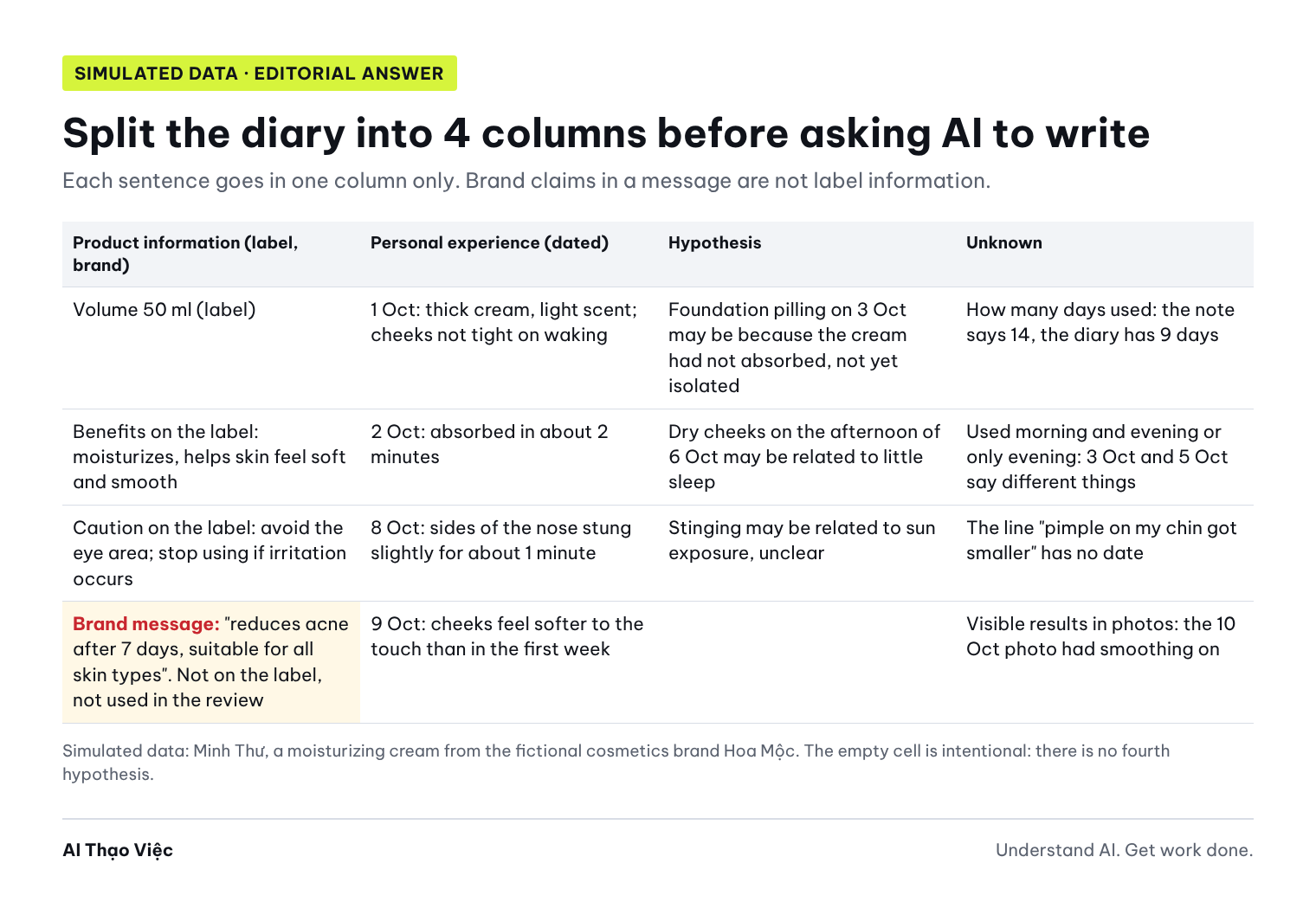
Editorial answer (written by the editors, not yet run on a real tool):
| Column | Must include | Must not include |
|---|---|---|
| Product information | L1 to L4; H1 on a separate line "brand claim, not on the label" | H1 grouped with the label |
| Personal experience | N1, N2, N3, N5, N6, N7, N9, each line with a date | N10 (no date) |
| Hypothesis | Foundation pilling may be because the cream had not absorbed or because of a later step; dry cheeks may be due to little sleep; stinging may be related to sun exposure | A hypothesis written as a conclusion |
| Unknown | Number of days used (G1 says 14, the diary has 9 days); N3 and N4 conflict; N10 has no date; photo B is smoothed, photo C has different lighting from photo A | Picking one side when N3 and N4 conflict |
Step 2. Check dates and conflicts
This is where AI often "rounds up" for you. The diary has 9 dated entries: 1, 2, 3, 5, 6, 8, 9, 10 and 12 Oct. From the first day to the last is 12 days. You may have used the product on the days with no entry, but the review has no basis to say so.
Based on the diary I pasted, answer each question, with source codes:
1. How many days have entries in the diary? List them.
2. What are the first and last days with entries?
3. G1 says "14 days". Does the diary give enough basis for that?
4. Which entries have no date?
5. Which two entries contradict each other? Quote both, do not pick a side.
If there is not enough data, write exactly "unclear".
Editorial answer: 9 days; first 1 Oct, last 12 Oct 2026; G1 has no basis, write "actual number of days used unclear"; N10 has no date; N3 conflicts with N4. Only you know which one is right. If you do not remember for sure, the review says "mostly in the evening" and mentions that one entry says otherwise.
Step 3. Arrange comments by readers' questions
Here are 6 questions readers of moisturizer reviews often ask:
1. What are the texture, scent and absorption like?
2. Does it pill when used before foundation?
3. Is there anything you did not like?
4. Under what conditions, and for how long, was it used?
5. Will it suit my skin?
6. Did the writer receive a sample or money from the brand?
For each question, list the diary entries that answer it (codes N, Q) and a short
answer based only on those entries. If the diary cannot answer a question,
write "the diary cannot answer this" and say why.
Editorial answer: question 1 uses N1, N2; question 2 uses N3, noting that the cause has not been isolated; question 3 uses N3, N5, N6; question 4 uses N1 and the step 2 result; question 6 uses Q1, Q2. Question 5 must be "the diary cannot answer this": one person's diary does not show whether the product suits someone else's skin.
Step 4. Have AI draft the review from the evidence
To keep the review in your own voice, also paste 2 to 3 paragraphs from your past posts, as in the article Ask AI to write in your own voice (in Vietnamese).
Write a review of about 250 words, first person, friendly tone, based only
on the 4-column table and the answers above. Rules:
1. Start with a sentence disclosing the relationship with the brand, taken from Q1, Q2.
2. Every comment about how it felt includes the date of the entry.
3. Number of days used: only say "9 days with diary entries, from 1 Oct to 12 Oct".
4. Do not use H1 or N10. Do not mention acne, melasma or skin conditions.
5. Do not say the product suits everyone, is safe, or causes no irritation.
6. Report N6 exactly as a sensation, without judging how serious it was.
7. Do not use photos B and C for a before-and-after comparison; say why.
8. Include a section "What this review cannot tell you".
At the end, list "Points for me to check".
Editorial answer (sample review, use it as a framework):
Hoa Mộc Moisturizing Cream 50 ml: my 9-day diary

Hoa Mộc gifted me 1 jar on 30 Sep 2026, and I was not paid.
Hoa Mộc was allowed to preview this post but did not change the content.

How I used it: 9 days with diary entries, from 1 Oct to 12 Oct 2026,
mostly in the evening, in an air-conditioned room. My entry on 3 Oct says I also
used it in the morning, which differs from my entry on 5 Oct, so I will not claim how many mornings I used it.

How it felt: thick cream, light scent (1 Oct). Absorbed in about 2 minutes, not greasy
on the pillow (2 Oct). On 9 Oct my cheeks felt softer to the touch than in the first week.

What I did not like: on the morning of 3 Oct my foundation pilled at the sides of the nose; I have not tested
whether that was the cream or another step. On 8 Oct, after coming back from the sun, the sides of my nose
stung slightly for about 1 minute, then stopped.

What this review cannot tell you: whether the product suits your skin; results
beyond 12 days; a before-and-after comparison with photos, because the 10 Oct photo had smoothing on
and the 12 Oct photo was taken under yellow light.

According to the label: moisturizes, helps skin feel soft and smooth; avoid the eye area; stop using if
irritation occurs.

Points for me to check: whether I used it in the morning on 3 Oct.
Put the disclosure sentence at the very start of the post and of the video. Short templates to adapt to your real relationship: "This post features [product], gifted by [brand]; I was not paid"; "This is a paid partnership with [brand]"; "The link in this post is an affiliate link; I earn a commission if you buy through it".
TikTok's help page says creators must turn on the commercial content disclosure setting when posting content that promotes a brand, product or service; the post will show a "Paid partnership" or "Commercial content" label. Instagram has a "Paid partnership" label for branded content; check the current conditions in the app.
Law No. 75/2025/QH15 amending and supplementing a number of articles of the Advertising Law (Luật sửa đổi, bổ sung một số điều của Luật Quảng cáo, in force from 1 Jan 2026) has Article 15a on people who deliver advertising products. For influencers, it requires verifying the reliability of the advertiser and checking documents about the product; "if they have not used or do not clearly understand the product, goods or service, they must not introduce it"; and announcing the advertising right before and during it. Whether your gifted-sample review falls within this scope, this article does not conclude. This is not legal advice; ask a qualified professional before signing a collaboration or publishing paid content.
Step 5. Trace every sentence back to the data
Split the review you just wrote into individual sentences. Make a 4-column table:
Sentence | Source code (L, N, Q) | Date | Level: "matches the diary", "stronger than
the diary" or "no source".
Do not fix any sentence yet. At the end of the table, count the sentences at each level.
Editorial answer: for the sample in step 4, every sentence is at the "matches the diary" level; the "What this review cannot tell you" section draws on step 2 and the photo entries. Any sentence with "no source" should be deleted or turned into a question for you to answer. Keep this table with the diary so you can answer when someone asks "what is this based on".
Spot wrong output
If you only type "write a great review for this moisturizer" with the draft note and the brand's message, AI easily returns sentences like those in the image below.
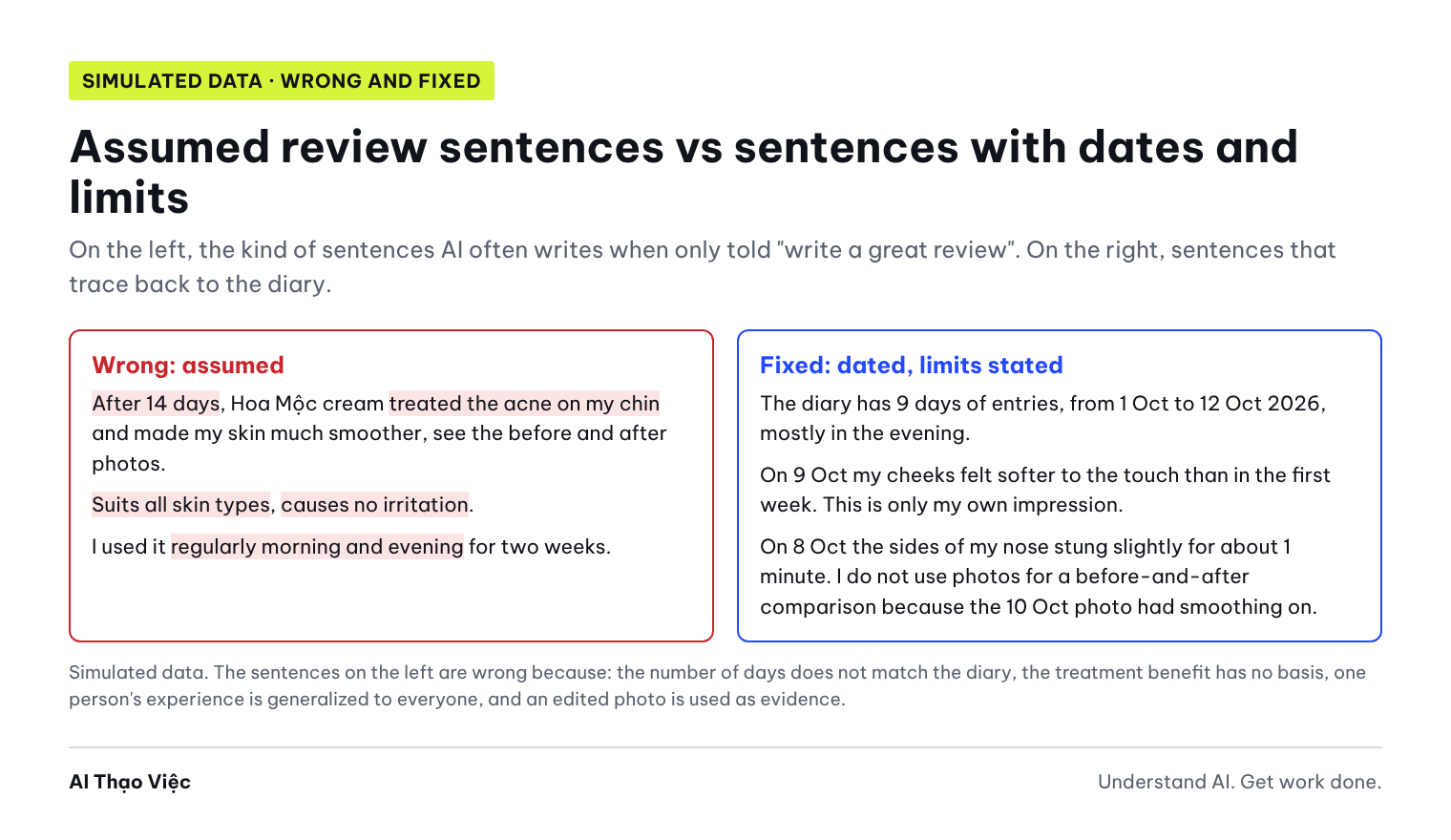
- Number of days taken from the draft note: "after 14 days" when the diary has 9 dated entries. Count the days again.
- Treatment benefits: "treats acne", "clears melasma" are claims about a condition. The only sources are N10, which has no date, and H1, which is not on the label. Law 75/2025/QH15 amending the Advertising Law (in force from 1 Jan 2026) requires advertising content to be truthful, accurate and clear, and not misleading about a product's features, quality or benefits (PDF of Law 75/2025/QH15, in Vietnamese). This is not legal advice; ask a qualified professional before posting.
- Generalizing from one person to everyone: "suits all skin types", "causes no irritation". One person's diary cannot support this, and there is even a stinging entry on 8 Oct.
- Edited photos used as evidence: photo B has smoothing on, photo C has different lighting from photo A. Photos should only illustrate the product and texture (photo D).
The review you just wrote has sentences that do not match the diary. Fix them using these rules:
1. Replace "14 days" with "9 days with diary entries, from 1 Oct to 12 Oct".
2. Delete every sentence about acne, melasma, curing, treating or skin conditions.
3. Delete "suits all skin types" and "causes no irritation"; report N6 exactly.
4. Delete the invitation to look at before-and-after photos; say why photos B and C are not used for comparison.
5. N3 and N4 conflict: write "mostly in the evening" and mention that one entry says otherwise.
Return the corrected version and a list of changed sentences, each with a reason.
When the diary records a skin reaction: the review states exactly what you felt and the date of the entry, without naming the reaction or judging how serious it was. If your skin shows unusual signs, stop using the product and ask a qualified medical professional. This article does not give treatment guidance; if AI adds treatment advice on its own, delete that part.
Exercises
- Run prompts 1 to 5 with the simulated diary, compare with the editorial answers, and note where AI did something different.
- Follow-up exercise: take your real diary for one product, remove private details, and run prompts 1 and 2 before writing any sentence.
A suggestion for workshops or classes: give each group the simulated diary, have them fill in the 4-column table by hand first, then compare it with the table AI makes; spend extra time on the "Unknown" column.
Use it with your own data
- From your next trial, note each use: date, time of day, conditions, how it felt.
- Type the benefits, directions and cautions exactly as worded on the label, coded L. Put the brand's words from messages or briefs in a separate H section; for any claim not on the label, ask before mentioning it.
- Note the relationship: gifted sample, paid, affiliate link, preview rights. If it comes through a shop, check the brief as in the article Sending products to affiliate creators (in Vietnamese).
- Note each photo: date, native camera or edited, lighting.
- Run prompts 1 to 6. You are the final approver; for paid posts, the brand may review the product information part, but the experience part remains yours.
Check before you use it
- The sample or sponsorship disclosure is at the very start of the post and matches the real relationship.
- The number of days used matches the number of dated diary entries.
- Every comment about how it felt has the date of the entry.
- Product information comes from the label, not from promotional claims in messages.
- No words suggesting treatment benefits: treats, cures, clears acne, clears melasma, specialized treatment.
- No sentences generalizing to everyone: suits all skin types, works for everyone.
- No edited photos or photos with different lighting used for before-and-after comparisons.
- Conflicts are clearly noted, not resolved by AI for you.
- There is a section "What this review cannot tell you".
- The platform's disclosure setting is turned on when the content involves a commercial relationship.
When things go wrong
- AI still writes "treats acne" after you prohibited it: remove N10 and H1 from the pasted data and rerun prompt 4.
- AI merges two conflicting entries into one smooth sentence: rerun prompt 2 and require it to quote both entries word for word.
- The brand asks you to add a benefit claim: ask for official documents or the label wording for that claim; claims about curing conditions, or claims without documents, do not go into your experience section.
- The diary covers too few days: write a "first impressions" post and state the number of days clearly.
- Not sure how to disclose: read the platform's help page, ask the brand, and ask a qualified legal professional if there is a paid contract.
Limits and sources
The characters, brand, diary and photos are simulated; the answers were written by the editors and have not been run on a real AI tool. This article does not assess the effectiveness or safety of any product and does not replace the opinion of a qualified medical professional. The regulatory part only quotes short points from the sources opened, and is not legal advice. Sources opened on 31 Oct 2026:
- Luật sửa đổi, bổ sung một số điều của Luật Quảng cáo, No. 75/2025/QH15 (Law amending and supplementing a number of articles of the Advertising Law) (version on the Hanoi city government portal): Article 15a on people who deliver advertising products; the requirement that advertising content be truthful, accurate and clear, and not misleading about a product's features, quality or benefits.
- TikTok: About the content disclosure setting for creators.
Read next: Handling brand collaboration invites and From portfolio to case study, keeping the evidence (in Vietnamese).