Nail and lash studio schedules often break because of a constraint nobody wrote down: this technician does not do lashes, that bed has not been cleaned yet, she does volume 20 minutes slower. If the person taking bookings keeps it in their head, it still works; when you hand over to someone new, or want AI to check the schedule, those constraints must become tables.
This is article 1 in a two-part series on scheduling for nail and lash studios. This article standardizes the data; article 2 uses that data to find overlaps in a day's schedule. If you are choosing between booking software and doing it by hand, see the article comparing three levels; this article goes into the constraints themselves: people, stations, time.
The task and the output
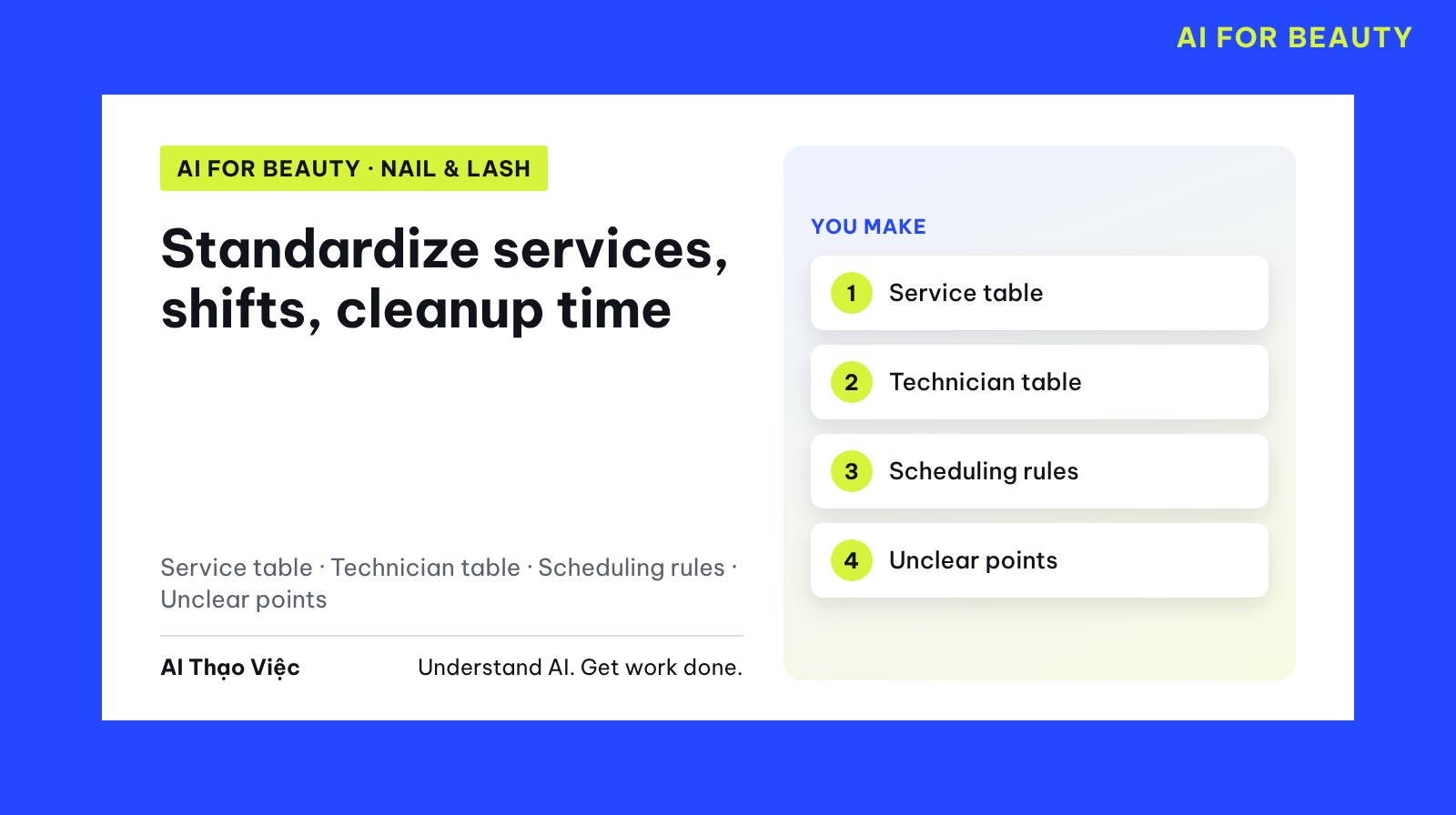
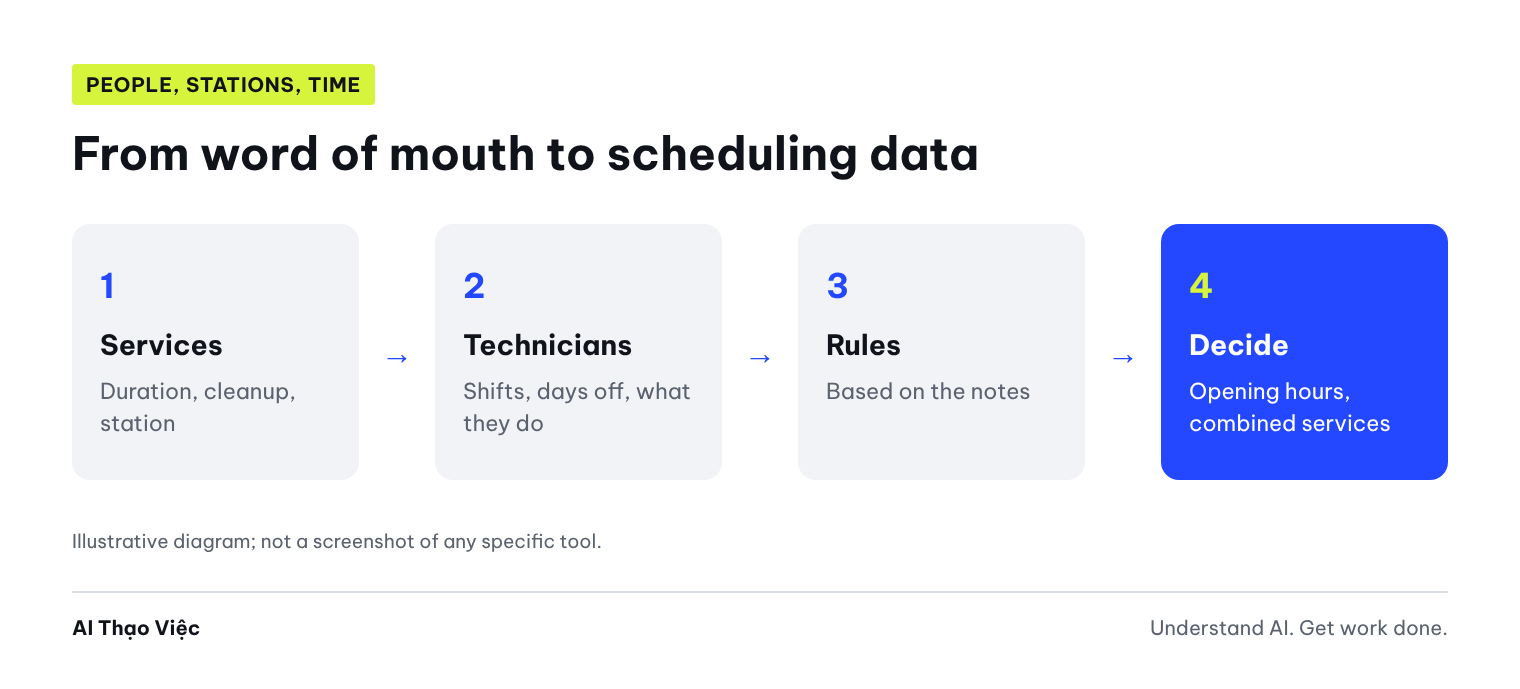
Three tables and one list:
- Service table: standard duration, technician-specific duration, cleanup time, station needed (nail table or lash bed).
- Technician table: shift, days off, services they can do.
- Scheduling rules with a basis: one technician, one client at a time; one station, one client at a time; cleanup time; no going past the shift.
- A list of unclear points the owner must decide.
Booking software calls tables, beds and machines "resources": attach a resource to a service and the system holds that station automatically and prevents double booking. The tables you build here are exactly the data you will need if you move to software later.
Step 1: write down how the studio runs now
Ask the owner and each technician, and write down their exact words. Do not round anything yourself. Simulated notes used in the test:
The studio has 3 nail tables, 2 lash beds. Technicians: Lan (does nails, shift 9:00-17:00), Mai (does both nails and lashes, shift 10:00-19:00), Hoa (does lashes, shift 12:00-20:00, off on Mondays).
Gel polish hands 45 min, gel polish feet 50 min, acrylic 90 min, gel removal 15 min (add extra if the client has old gel). Classic lash extensions 90 min, volume 120 min, lash fill 60 min, lash removal 20 min.
Table cleanup 10 minutes after each nail client, lash bed 15 minutes.
Mai is slower at volume, usually 140 min.
For a hand + foot combo, one technician does it back to back.
Step 2: ask AI to standardize
You are helping the owner of a nail and lash studio standardize information for scheduling.
THE OWNER'S NOTES (verbatim): [paste].
REQUIREMENTS:
1. SERVICE TABLE: service | group (nails/lashes) | standard duration | technician-specific duration (if any) | cleanup time after the client | station needed (nail table/lash bed).
2. TECHNICIAN TABLE: technician | shift | days off | services they can do.
3. SCHEDULING RULES drawn from the notes (one technician, one client at a time; one station, one client at a time; cleanup time; outside shift...). Only list rules that have a basis in the notes.
4. LIST OF UNCLEAR POINTS the owner must decide before using this for scheduling.
Do not add any durations or rules that are not in the notes.
Results from the test run
Tổ Thạo Việc (the AI Thạo Việc editorial team) ran it on 2 Oct 2026 on ChatGPT web, temporary chat, Medium level.
- An 8-line service table with correct durations, a separate "Mai: 140 minutes" for volume, and cleanup of 10 or 15 minutes depending on the station.
- The technician table recorded Hoa off on Mondays, while Lan's and Mai's days off were marked "not recorded", without assuming they work all week.
- 9 rules, all with a basis: no more than 3 nail clients and 2 lash clients at the same time; Mai's volume uses 140 minutes; a combo is done back to back by one technician.
- Valuable points to decide: which services "add extra for old gel" applies to; whether cleanup time takes up the technician's time or someone else cleans; whether a combo gets one cleanup after the whole combo or two; whether Mai needs prep time when switching between a nail table and a lash bed; whether "does nails" means all nail services or some are excluded; no meal breaks or latest start times yet.
What AI missed:
- It did not ask about the studio's opening and closing hours. Without a closing time, late clients cannot be checked.
- It did not record the hand + foot combo duration (45 + 50 = 95 minutes), leaving the person taking bookings to add it up.
- It listed "gel removal" as a separate service with 10 minutes of cleanup after it. If gel removal is done right before a new polish for the same client, this adds an unreasonable 10 minutes to the schedule.
Step 3: finalize the data
- Answer each unclear point and write it into the table, not just in your head.
- Add opening and closing hours and the latest start time for long services.
- Record the duration of combined services (combo, gel removal + new polish) as a separate line.
- Decide who cleanup time blocks: only the station, or the technician too. Article 2 assumes it blocks both.
- Have each technician read back their own line: does the real duration match? If a technician is slower than standard, record it separately, as with Mai.
Self-check
- Does every service have a duration, cleanup time and station needed?
- Does every technician have a shift, days off and a list of services they can do?
- Are opening and closing hours recorded?
- Do combined services have their own duration?
- Have the technicians confirmed their own lines?
Apply and hand over
Save the three tables in one file, with the date and who approved it. A new person taking bookings learns from this file instead of relying on word of mouth. When there is a new technician, a new service or a shift change, update the tables first, then take bookings under the change.
Next steps
Once your data is standardized, go to article 2: find conflicts in a day's schedule, fix them and confirm on the real calendar.
Sources & notes
- Square Support Center: Create, edit, and assign resources for appointments: explains that "resources" are rooms, tables and equipment attached to services; when a booking is made, the system holds that resource so it cannot be double booked. Checked 2 Oct 2026. Cited to explain the concept, not as a recommendation to use Square.
- The notes are simulated; the prompt was run once on ChatGPT. No commercial relationship with the sources above.